6 min read 26 Nov 2026
Appointment and remuneration of managerial personnel explained simply
CA MONK Team
Article Topics
A company is owned by its shareholders, but someone has to run it day to day. The Companies Act, 2013 sets rules on the appointment and remuneration of managerial personnel, the people who do that: who can be appointed, for how long, and how much of the company's profit they can be paid.
The point is to stop the people in charge from paying themselves whatever they like out of money that belongs to all the shareholders.
The top person running the business is usually called the managing director. A director who works in the company full time is a whole-time director. Together with a few other senior officers, these are the people the law cares most about.
Take Sunrise Bakeries Ltd, a public company with 40 bakery outlets across Pune and Mumbai. Its shareholders have put in ₹12 crore of share capital. This year, its profit, worked out the way the Act requires (net profits), is ₹10 crore. The board wants to make the founder, Rohan, managing director, bring in his father Mohan as a whole-time director, and pay both of them. Here is what the law makes the company check, in the order it happens.
The first check is on the people. Nobody under 21 can be a managing director, whole-time director or manager. Nor can someone who has been declared unable to pay their debts (insolvent), who has stopped paying creditors or made a deal with them to accept less, or who has been convicted and sentenced to more than six months in prison. Rohan is 45, with a clean record, so he passes.
Mohan is 72. Someone over 70 can still be appointed, but only if the shareholders approve with a bigger majority than usual (special resolution). That means the votes for must be at least three times the votes against. At the meeting, 900 votes are cast for Mohan's appointment and 200 against. Three times 200 is 600, and 900 is more than 600, so the resolution passes.
Rohan's term is set at five years, the longest the law allows at a time. He can be reappointed after that, but the company cannot do it more than a year before his current term ends. A company also cannot have both a managing director and a manager at the same time; Sunrise has chosen a managing director.
Sunrise's size brings one more duty. Every listed company, and every other public company with ₹10 crore or more of share capital, must have three kinds of full-time senior officers (key managerial personnel). These are a managing director or chief executive, a company secretary and a chief financial officer. Sunrise's ₹12 crore is above ₹10 crore, so alongside Rohan it hires a company secretary and a finance head.
Once the appointments are made, the company tells the government's Registrar of Companies through online forms. Form DIR-12 reports the new directors and senior officers within 30 days. Form MR-1 reports the appointment of the managing director and whole-time director within 60 days.
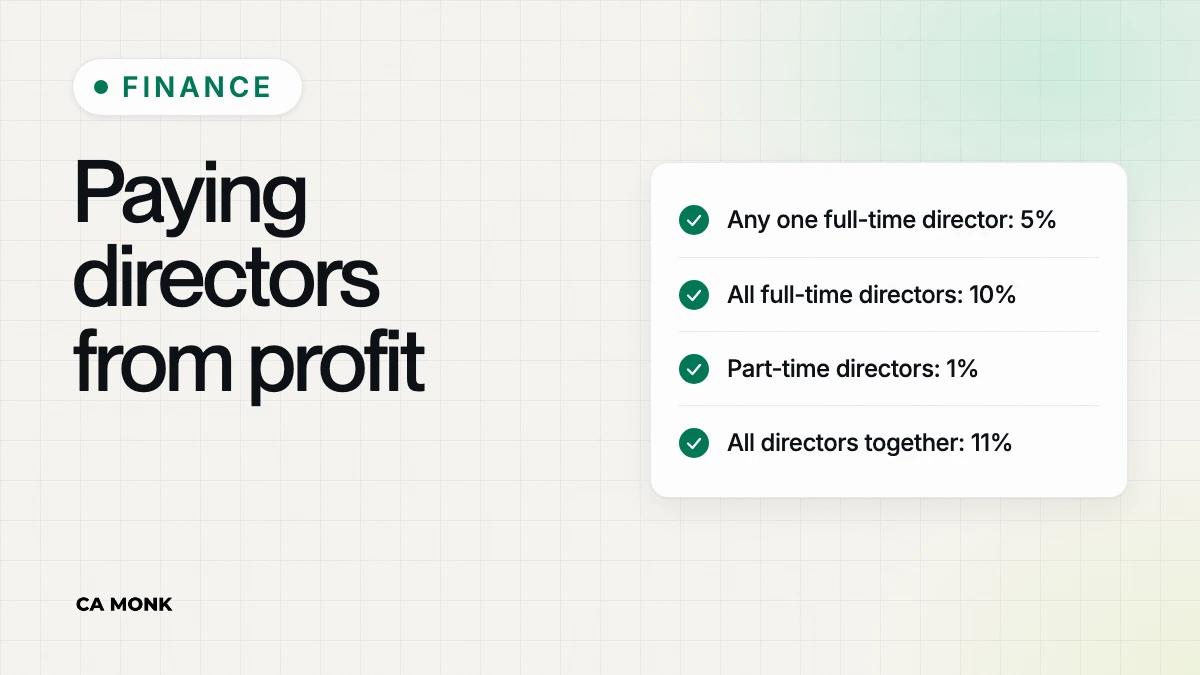
Now the pay. The law caps what a public company pays its directors as a share of its net profits. Here is each cap, worked out on Sunrise's ₹10 crore.
The board proposes ₹60 lakh a year for Rohan, ₹40 lakh for Mohan, and ₹12 lakh of commission shared among the directors who do not work in the company full time.
So, as proposed, the plan breaks three caps. Sunrise has two ways out. It can cut the pay to fit. Or the shareholders can approve the higher pay by special resolution, which the law allows for both the 5% cap and the 11% cap. If a company has failed to repay a bank or another secured lender, that lender must agree first.
Sunrise does both. Shareholders pass a special resolution for Rohan's ₹60 lakh. The board trims the part-time directors' commission to ₹10 lakh. The final pay is ₹60 lakh plus ₹40 lakh plus ₹10 lakh, which is ₹1.1 crore, exactly 11% of profit. That is what Sunrise pays its directors for the year.
The caps are a share of profit, so a year with little or no profit is a problem. Say next year Sunrise makes almost nothing because two outlets flood. It can then pay its managing director only within fixed limits set out in a schedule of the Act. To pay more than that, it must get the Central Government's approval first, using Form MR-2.
Two mistakes come up often. One is applying these percentage caps to every company. They are written for public companies; a private company has more freedom, within its own rules and approvals. The other is appointing someone over 70 on an ordinary vote. An ordinary vote is not enough to appoint someone over 70.
Not in one go. Each term can be at most five years. The company can reappoint the person again and again, but never earlier than a year before the current term ends. A founder appointed from 1 April 2026 for five years could be reappointed from 1 April 2030 at the earliest.
Yes, but the shareholders must approve with a special resolution, where votes for are at least three times votes against. Say 700 votes are for and 300 against. Three times 300 is 900, and 700 is less than that, so the special resolution fails. Because more votes were for than against, the company can still ask the Central Government to allow the appointment.
The percentage caps are written for public companies. A small private company paying its two founder-directors ₹50 lakh each from ₹2 crore of profit is not held to the 5% and 11% caps. It still follows its own rules and approvals.
This post was checked against the law in November 2026. Laws change, so read the official text before you act on it.
To see how other company law rules work in practice, these posts are a good next step.

CA MONK Team
CA Career & Learning Platform
CA MONK Team is the team behind CA Monk, India's CA career and learning platform. We help Chartered Accountants and CA aspirants build skills, explore career opportunities, connect with mentors, and navigate their professional journey through courses, mentorship, career tools, placements, and practical industry insights.
What does CA do in India? Learn the real roles, duties, and scope of CA work. Simple and student-friendly guide.

