6 min read 27 Nov 2026
Audit planning explained simply: how an auditor decides what to check
CA MONK Team
Article Topics
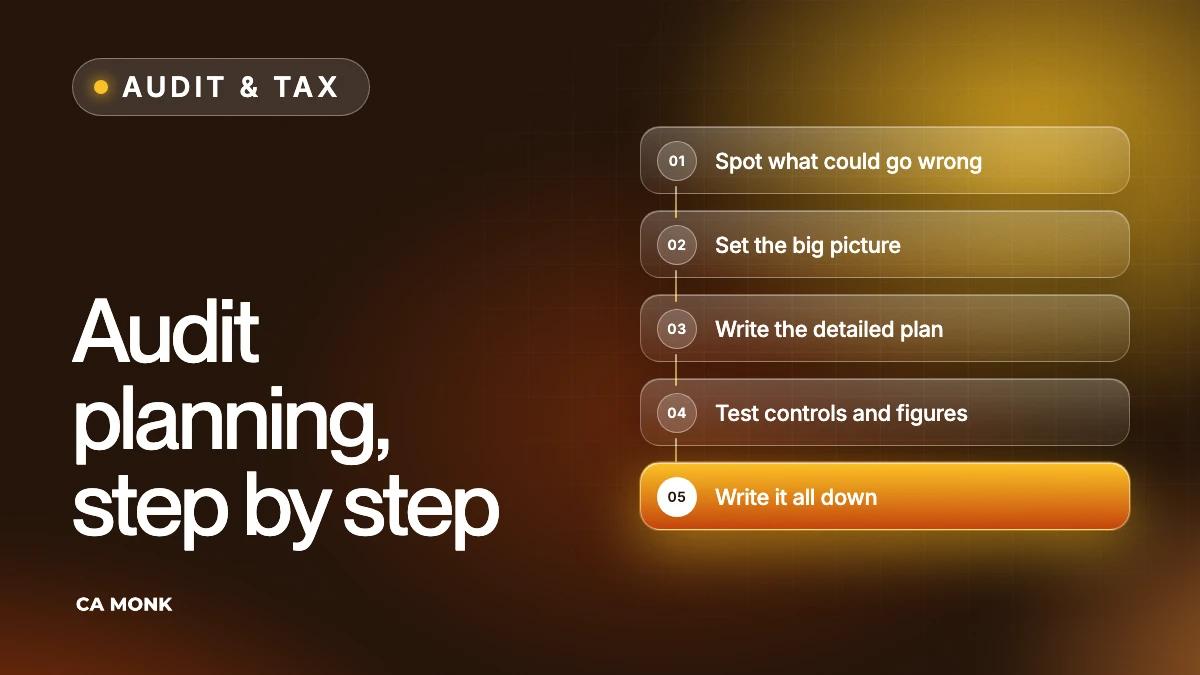
An audit is an outside accountant checking that a business's accounts are right. Audit planning, strategy and execution is how that check is organised. The auditor first learns the business and works out where a wrong figure is most likely. Then she decides where to spend her time, does the tests, and writes down what she found.
Take Sunrise Bakes, a private company that runs three bakeries in Nagpur and takes online orders. Its year ends on 31 March. Its owner, Mr Joshi, has appointed Kavita, a Chartered Accountant, to audit the accounts. The accounts say Sunrise sold ₹5,00,00,000 of cakes and bread this year. Kavita cannot check every bill, so she has to choose what to look at closely.
Step 1 turns up something odd. To see how fast sales grew, she takes last year's ₹4,00,00,000 from this year's ₹5,00,00,000. That is a rise of ₹1,00,00,000. Dividing it by last year's figure, ₹1,00,00,000 ÷ ₹4,00,00,000, gives 25%. But flour bought rose only from ₹80,00,000 to ₹84,00,000. That rise of ₹4,00,000, divided by ₹80,00,000, is just 5%. A bakery selling a quarter more should be buying a lot more flour.
Kavita writes the risk down precisely. "Sales are risky" tells her nothing about what to test. Instead she writes: "Online orders paid in March but delivered in April may have been counted as this year's sales." Now she knows what to look for and where.
So in her plan she puts more of her time on sales made in the last weeks of March. She pulls the March online orders and checks each one's delivery slip.
She finds that ₹20,00,000 of cakes were paid for in late March but delivered in the first week of April. Money paid in advance for goods not yet delivered is not a sale yet: it counts as revenue only when the goods are delivered. So these belong to next year. To get the right figure, she takes them away: ₹5,00,00,000 − ₹20,00,000 = ₹4,80,00,000.
This changes her plan. She now also checks the first two weeks of April, to see whether more orders crossed the year end. The auditing standards require her to update her plan when the facts change, and to record what she changed and why.
Mr Joshi's accountant corrects the accounts. Sunrise Bakes reports sales of ₹4,80,00,000 for the year. The ₹20,00,000 goes into next year's sales, when the cakes were actually delivered.
Note what Kavita did not do. The discount approvals in step 4 all worked well, but she still checked the sales figures themselves. Good internal checks never remove the need to test the figures for every amount large enough to matter. Nor was her first look at the numbers in step 1 enough proof on its own: it only told her where to dig.
In statutory audits in India, this planning shapes the daily work on sales, amounts owed by and to others, stock, fixed assets, deals with related parties, and legal compliance. The risk assessment decides which balances get more testing and what proof will convince.
On the business side, an accountant preparing for audit gets the books balanced, keeps the supporting bills, prepares draft accounts and bank reconciliations, and keeps proof of statutory filings ready. Those are what the auditor's planned tests are run on.
The standards behind the steps are SA 315 (learning the business and its risks), SA 300 (strategy and plan), SA 330 (the tests) and SA 230 (the written record). The record must be clear enough for an experienced auditor who had nothing to do with the job to follow what was done and why.
No. She checks more where a wrong figure is likelier and matters more. A shop with ₹2,00,00,000 of sales might have every big March bill checked, but only a small sample of ₹500 counter sales from June.
No. Good checks can reduce how much she tests, but she still tests the figures for every amount large enough to matter. Even if every discount was approved, she still matches a sample of ₹5,00,000 of sales to bank receipts.
Yes, and it should when something turns up. If a test finds ₹10,00,000 of sales in the wrong year, the auditor widens her checks to nearby dates and records what she changed and why.
If you want to see how other parts of an audit work, these posts are a good next read.
Statutory Audit Masterclass

CA MONK Team
CA Career & Learning Platform
CA MONK Team is the team behind CA Monk, India's CA career and learning platform. We help Chartered Accountants and CA aspirants build skills, explore career opportunities, connect with mentors, and navigate their professional journey through courses, mentorship, career tools, placements, and practical industry insights.
Confused between internal audit vs statutory audit? Learn their differences, objectives, benefits, and importance for compliance.


