7 min read 29 Nov 2026
Board meetings under the Companies Act, 2013: how directors decide
CA Shivam Palan
Article Topics
A company is run by a group of people chosen to steer it (Board of Directors). They decide together, as one body, at board meetings. They do not decide things one by one over the phone. The Companies Act, 2013 sets out how often those meetings are held, how directors are told of them and how many must be present.
The board can do anything the company itself is allowed to do. There are two limits. It must stay within the law and the company's own founding documents. And it cannot take a decision that the law or those documents keep for the shareholders' meeting (general meeting).
Take Crumb & Co Bakeries Private Limited. It runs three bakeries in Indore and wants to open a fourth. It has nine directors. Six of them are members of the Sharma family, who founded it. The other three are outsiders: a retired banker, a chef and a friend of the family who runs a dairy.
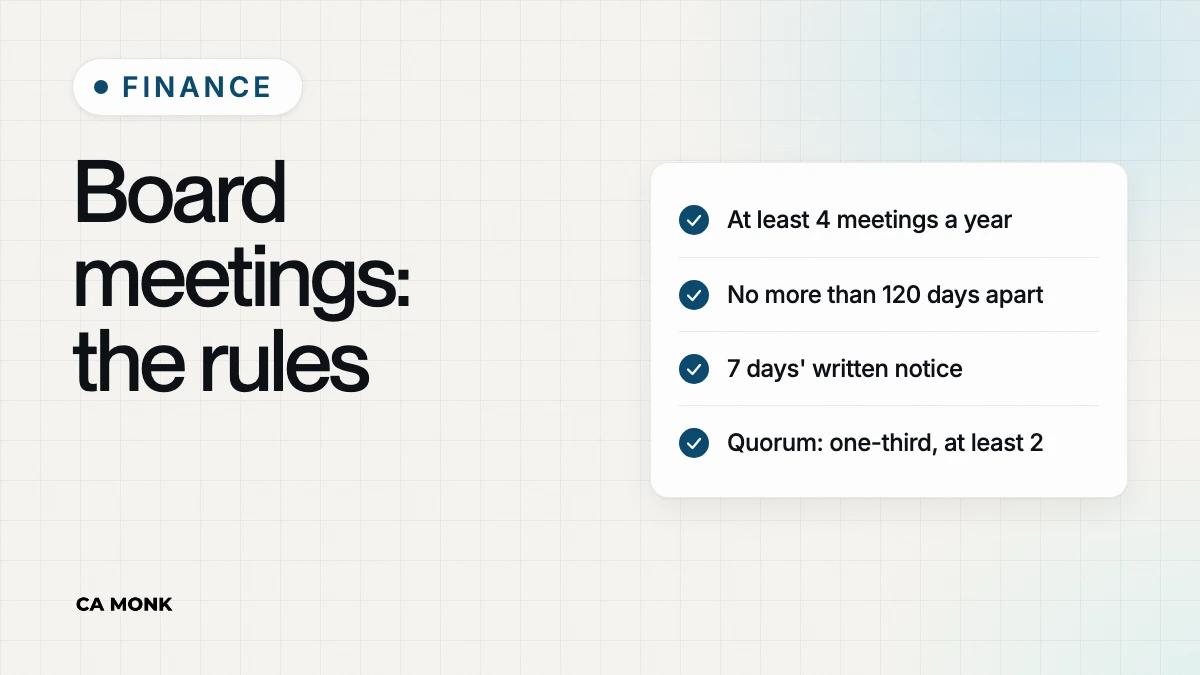
A meeting counts only if enough directors are present (quorum). The rule is one-third of the board, or two directors, whichever is higher. One-third of nine is 9 ÷ 3 = 3. Three is higher than two, so at least 3 of Crumb & Co's nine directors must be present.
How often. A new company holds its first board meeting within 30 days of being formed. After that, every company holds at least four board meetings a year, with no more than 120 days between one meeting and the next. Crumb & Co meets on 10 April. To find the latest date for the next meeting, count 120 days forward from 10 April: 20 days left in April, 31 in May, 30 in June and 31 in July make 112, and 8 more days in August make 120. So the next meeting must be held by 8 August.
A one-person company, a small company or a dormant company needs only one meeting in each half of the calendar year, at least 90 days apart.
Telling the directors. Each director must get at least seven days' written notice, sent to the address the company holds for them, by hand, post or email. Crumb & Co's chairperson wants a meeting on 20 May, so the notice must go out by 13 May. A meeting can be called at shorter notice for urgent business. If the company has independent directors, at least one must then attend. If none attends, the decisions go round to every director and become final only once at least one independent director agrees.
Joining from elsewhere. A director can attend in person or by video call, as long as the system can record who took part and store the proceedings with the date and time. Someone joining by video counts towards the quorum. The chairperson and the company secretary, if there is one, must check who is on the call, keep it secure and see that it is recorded. Since June 2021, even the yearly accounts and the board's report can be approved at a video meeting.
On 20 May the agenda includes renting a shop for the fourth bakery. The shop belongs to a firm owned by the Sharma family, so all six Sharma directors stand to gain from the deal (interested directors).
Here the ordinary quorum rule changes. When the directors with a stake make up two-thirds or more of the whole board, the quorum is the number of directors without a stake who are present, and there must be at least two of them. Two-thirds of nine is 9 × 2 ÷ 3 = 6. The Sharmas are exactly six, so the special rule applies.
Say eight directors turn up: all six Sharmas and two of the three outsiders. A simple headcount says 8, far above the usual 3. But the count that matters is the outsiders present, which is 2. That meets the minimum of two, so the meeting can decide the rent.
Now say only one outsider turns up, with all six Sharmas. Seven people are in the room, yet only one director without a stake is present. That is below two, so there is no quorum for this item, and the rent cannot be approved.
Passing a decision on paper. Between meetings, the board can pass a decision by sending the draft, with its papers, to every director at the address the company holds for them (resolution by circulation). It passes if a majority of those entitled to vote approve. In June, Crumb & Co needs to sign an order for a ₹6,00,000 oven quickly. The draft goes to all nine directors. A majority of nine is 5, so five approvals would pass it. But if one-third of the directors, 9 ÷ 3 = 3, ask for the oven to be decided at a meeting, the chairperson must put it to a meeting instead.
Decisions that need a meeting. Some powers can be used only by a decision taken at a board meeting. They include calling for unpaid share money, buying back shares, issuing shares or other securities, borrowing money, investing the company's funds, giving loans, guarantees or security, approving the yearly accounts and the board's report, moving into a new line of business, and mergers or takeovers. So when Crumb & Co wants a bank loan of ₹40,00,000 for the fourth bakery, it cannot pass that on paper. It must be decided at a meeting.
Handing some of it on. At a meeting, the board can pass three of those powers (borrowing, investing, and giving loans, guarantees or security) to a committee of directors, the managing director, the manager or another senior officer, on conditions it sets. Crumb & Co's board lets its managing director borrow up to ₹5,00,000 at a time for day-to-day needs, without coming back to the board.
The moment that matters most is the yearly accounts. The board must approve the accounts and the board's report by a resolution at a meeting. The most common mistake is the one in the rent example: counting heads without leaving out directors who have a stake in the decision.
One-third of the board, or two, whichever is higher. A board of six needs two, because one-third of six is two. A board of twelve needs four. Directors joining by video call count towards that number.
Often, yes. The draft goes to every director, and it passes if a majority agrees. A board of seven needs four approvals. But borrowing, investing, approving the yearly accounts and some other decisions must be taken at a meeting, and one-third of the directors can insist on one.
No more than 120 days apart, and at least four in a year. If a board meets on 1 January, its next meeting must be on or before 1 May. A very small company only needs one meeting in each half of the year, at least 90 days apart.
If you want to read more about how companies are run and governed, these posts follow on from this one.

