Article Topics
Most things sold in India carry GST, which the seller collects from the customer and pays to the government. Exemptions under GST are the few things let off: the central government can declare goods or services free of GST, wholly or in part, on the advice of the GST Council, the body of central and state finance ministers.
The government does this by a formal notice, and the notice may come with conditions attached. A matching power covers GST on sales between states. Being let off sounds like pure gain for the seller. It is not. A seller of tax-free goods cannot claim back the GST it paid on its own costs for those goods. That hidden cost is the main thing to understand about exemptions.
Take Green Basket, a neighbourhood store. It sells fresh vegetables and fruit, and also packaged snacks and soft drinks. Fresh or chilled vegetables and fruit, such as potatoes, tomatoes, onions, bananas and apples, are free of GST. Say the snacks and drinks it sells all carry GST.
The law groups three things together as sales that carry no GST (exempt supply):
Green Basket's tomatoes fall in this group. Because they are fully let off, it must not add any GST to the customer's bill for them.
Exports are a different case and are often confused with this group. Goods or services sent out of India, or sold to a business in a special economic zone, also go out without GST being charged (zero-rated supply). But the law counts them with taxed sales, not with exempt ones, when it decides how much GST on costs a seller may claim back. That difference matters, as the next part shows.
When Green Basket buys snacks from a distributor, or pays rent for the shop, it pays GST on those bills. Normally a business takes the GST it paid on its costs off the GST it collected from its customers, and pays only the difference to the government (input tax credit). The law allows this only for costs that go into taxed sales, including exports. For costs that go into exempt sales, the credit is lost.
Some costs belong to one kind of sale only. The GST Green Basket pays on the snacks it buys for resale goes wholly into taxed sales, so it can all be claimed. Vegetables bought from farmers carry no GST, so there is nothing to claim.
Other costs serve the whole shop: the rent, the billing software, the fridges. GST paid on these is shared between taxed and tax-free sales (common credit). The GST rules split it by sales, in a set method (Rule 42). Take the GST on the shared costs. Multiply it by the store's tax-free sales and divide by its total sales. The answer is the part Green Basket must give up.
Say that in one month Green Basket sells ₹10,00,000 in all: ₹6,00,000 of fresh produce and ₹4,00,000 of snacks and drinks. Say it paid ₹40,000 of GST on the snacks it bought, and ₹30,000 of GST on rent, software and fridge repairs.
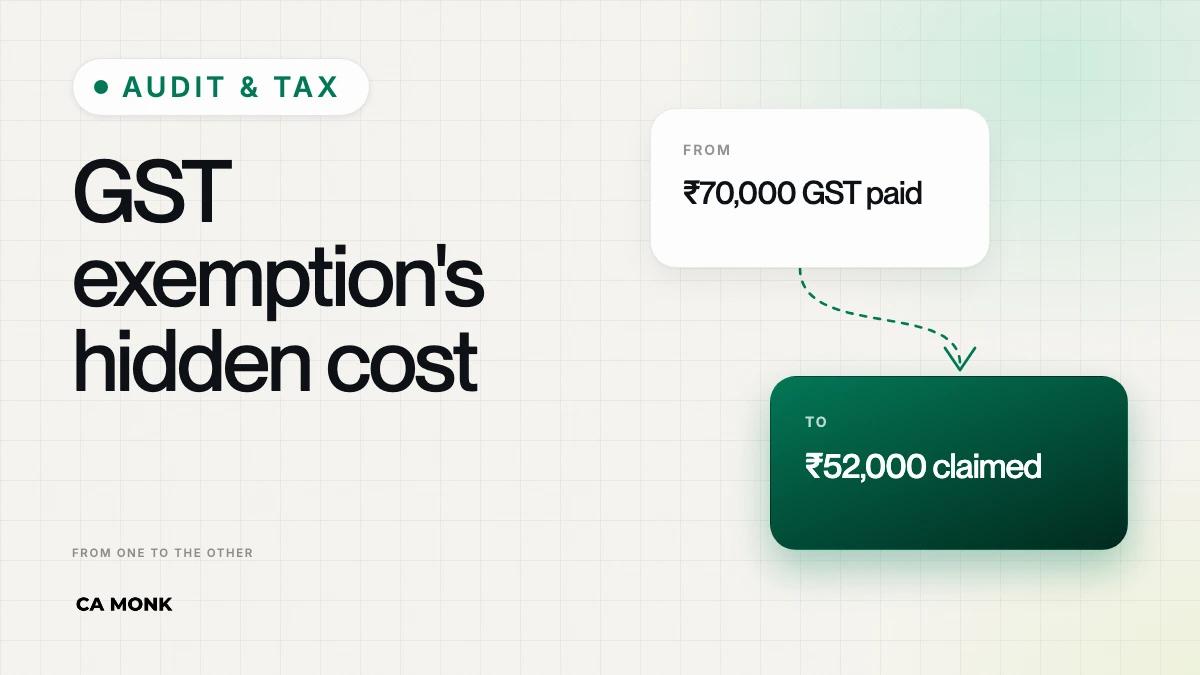
So Green Basket takes ₹40,000 + ₹12,000 = ₹52,000 off its GST bill this month, not the ₹70,000 it paid. The ₹18,000 is a real cost of selling tax-free vegetables.
The split is worked out each month, then again for the whole financial year. If the year's figure shows more should have been given up, the shop pays the gap with interest.
A seller who deals only in goods or services that are wholly exempt, or not taxed at all, does not have to register for GST. So a vegetable vendor who sells nothing but fresh produce checks this first: there may be no registration to do. Green Basket also sells taxed snacks, so this relief is not open to it, and it must do the split above.
Two mistakes are common.
Both reach the customer without GST, but the seller is treated differently: an exporter keeps the credit for GST on its costs, and a seller of tax-free tomatoes gives it up. If each paid ₹10,000 of GST on costs, the exporter can claim the ₹10,000 and the tomato seller cannot.
No. When something is fully let off GST, the seller must not collect GST on it. If Green Basket added ₹5 of GST to a ₹100 bag of fresh onions, it would be charging tax the law says it may not collect.
No, if every sale is wholly exempt or not taxed at all, whatever the sales figure. A fruit seller with ₹50 lakh of sales, all of fresh fruit, need not register. If the same seller also sells packaged juice worth ₹5 lakh, the shop is no longer selling only tax-free goods, so this relief no longer applies.
This post was checked against the law in November 2026. Laws change, so read the official text before you act on it.
If you want to read more about how GST and its credits work, these posts are a good next step.
Indirect Taxation Masterclass
Section 65 GST Audit Explained: Notice, Timelines, Rule 101, Penalties, and CA Tips. Learn how to prepare effectively.