Article Topics
Ind AS 10 (Events after the Reporting Period) is the rule for news that arrives after a company's year-end. The accounts show where the company stood on the last day of its financial year. But they are finished and signed weeks later, and news keeps arriving in those weeks. Some of it changes the year's figures, some is only told in a note, and some is ignored.
The test is simple. If the news tells you more about how things already stood on the last day of the year, the figures change. If it is about something that happened only after that day, the figures stay as they are, and a big enough event is described in a note.
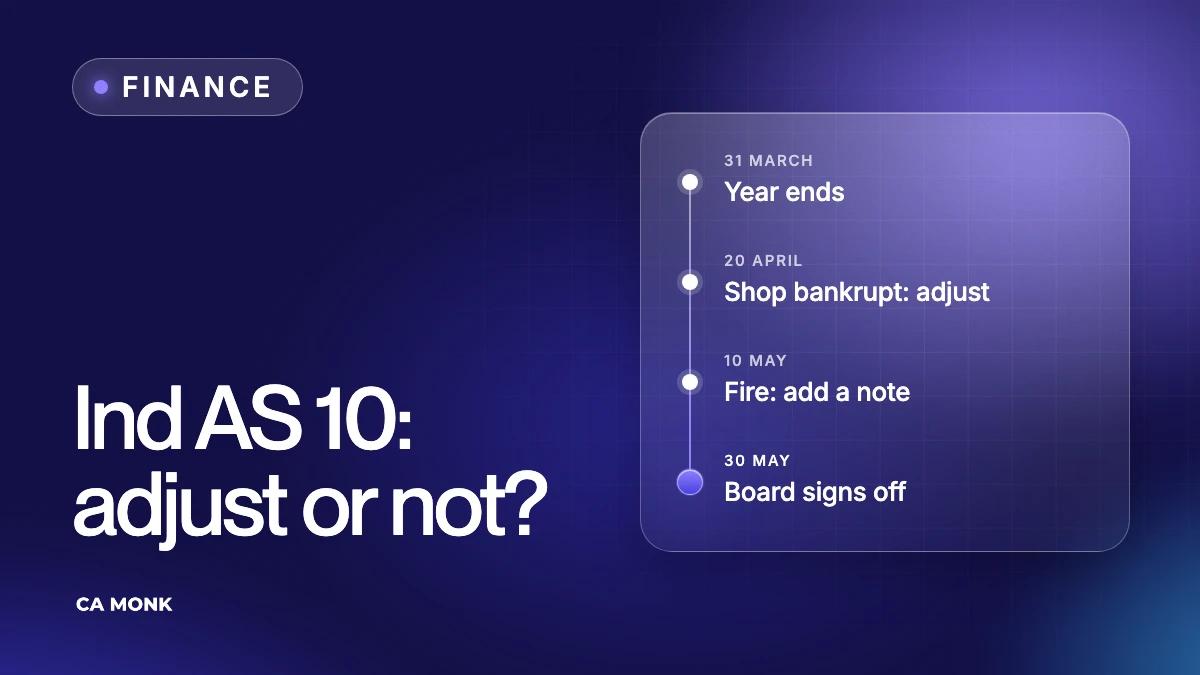
Meet Meera. Her company makes wooden furniture and sells it to furniture shops, who pay her 60 days after delivery. Her financial year ends on 31 March 2026 (the end of the reporting period). Her board signs off the accounts on 30 May 2026 (the date of approval for issue). Anything that happens between those two dates is called an event after the reporting period.
Before any news, her accountant's draft shows a profit of ₹10,00,000 for the year. Among the money owed to her on 31 March is ₹2,00,000 from one shop, for tables delivered in February.
20 April: the shop goes bankrupt. The shop that owed ₹2,00,000 is declared bankrupt. Meera will not be paid. Did this problem start in April? Almost certainly not. A shop does not collapse in three weeks. The bankruptcy confirms that, on 31 March, the ₹2,00,000 was already money she would not collect. So this news gives evidence about how things stood at year-end. It is an adjusting event, and the figures must change.
To fix the profit, take the draft profit and remove the money that will never come in: ₹10,00,000 − ₹2,00,000 = ₹8,00,000. The accounts now show a profit of ₹8,00,000, and the amount owed by customers falls by ₹2,00,000.
10 May: a fire in the store. A short circuit starts a fire in Meera's storeroom. It destroys finished chairs worth ₹3,00,000. On 31 March those chairs were fine. The fire is a new event that happened after the year ended. It is a non-adjusting event, so the figures for the year are not changed. The profit stays at ₹8,00,000, not ₹5,00,000, and the chairs still appear in the year-end stock.
But a loss of ₹3,00,000 matters to anyone reading the accounts. Leaving it out could change what a lender or an investor decides. So Meera's accounts must carry a note. It says what happened (a fire destroyed finished goods in May) and either gives an estimate of the money effect (about ₹3,00,000) or says that no estimate can yet be made.
15 May: a dividend. The board decides to pay shareholders a dividend of ₹1,00,000. This decision was made in May, so on 31 March the company owed its shareholders nothing. The dividend is not shown as an amount owed at year-end.
5 June: a big order. A hotel chain places its largest ever order. This comes after the accounts were signed on 30 May, so it is not considered for this year's accounts at all. The date of sign-off is the cut-off.
There is one kind of news that changes more than a single figure. Accounts are normally prepared on the basis that the business will keep running (the going concern basis).
Suppose that in May, after the fire, Meera's board decides to close the company, or accepts that it has no real choice but to stop trading. Then the year's accounts must not be prepared as if the business will carry on. This applies even though the decision came after 31 March.
The most common slip is to treat every piece of news after year-end as "after the date, so ignore it". The first question should always be: does this tell us more about how things stood on the last day of the year? The bankrupt shop is the classic case. The bankruptcy happened in April, but the bad debt was already there in March.
The second slip is to show a dividend decided after year-end as an amount owed at year-end. Meera's ₹1,00,000 dividend does not belong in her 31 March figures.
At work, an accountant closing the books goes through what has happened since year-end. That means court cases, customers who have failed, dividends declared and large losses of assets. For each one, they decide whether it confirms something that already stood on the last day, or is something new. The auditors then check that judgement. They check that every important event has been found, and that each has been either put into the figures or described in a note.
Yes, if the settlement confirms the company already owed the money on the last day of the year. Say a customer sued over faulty goods sold in January, and in April the company agrees to pay ₹50,000. That ₹50,000 goes into the year's accounts as an amount owed.
Usually not. A fall in market price after year-end normally reflects what happened after that day. If shares worth ₹4,00,000 on 31 March are worth ₹3,00,000 in April, the accounts still show ₹4,00,000. A large fall may need a note.
No. Only events up to the day the accounts are approved are considered. If the board signs on 30 May and a big order comes on 5 June, that order belongs to next year's story, not this year's accounts.
If you want to read more on how company accounts are prepared and corrected, these posts are a good next step.
Ind AS Masterclass
What does CA do in India? Learn the real roles, duties, and scope of CA work. Simple and student-friendly guide.