Article Topics
Some things a company owns are shown in its accounts at what they are worth today, not at what it paid for them. Ind AS 113 is the Indian accounting standard that says how to work out that "worth today" figure (fair value measurement).
Its answer, in short: the price the company would get if it sold the thing today, in a normal sale, to the kind of buyers who deal in such things. That price is called fair value. The standard does not decide which things must be shown at fair value; other standards do that. Ind AS 113 only says how to measure it once another standard asks for it.
Say Brightpath Coaching is a small company that runs tuition classes. Two years ago it put spare money into 1,000 shares of a listed company, paying ₹400 a share, so ₹4,00,000 in all. On 31 March, the last day of its financial year, those shares trade on the stock exchange at ₹500 each. To find what the shares are worth that day, multiply the number of shares by today's price: 1,000 × ₹500 = ₹5,00,000. That is the figure Brightpath shows, not the ₹4,00,000 it paid.
The standard's way of thinking can be followed as a short sequence. Here it is on Brightpath's shares.
Two points sit inside these steps.
It is a selling price, not a buying price (exit price). Brightpath might have to pay a little more than ₹500 to buy a share today. That does not matter. Fair value is what it would receive on selling.
Selling costs are not taken off. Say the broker would charge ₹5,000 to sell all 1,000 shares. It is tempting to show ₹5,00,000 − ₹5,000 = ₹4,95,000. That is wrong. The brokerage is a cost of the sale, not a feature of the shares, so the fair value stays ₹5,00,000. The cost only matters when choosing between two markets in step 2.
Now the land. Brightpath also owns a plot of land next to its classrooms, which it uses as a car park. As a car park, buyers would pay about ₹40,00,000 for it. But the plot sits on a busy road, local rules allow shops to be built on it, and building them would pay off. Buyers who deal in such land would pay about ₹60,00,000 to put up shops. Use is valued only if it is physically possible, legally allowed and makes financial sense, and the shop plan passes all three. So if another standard asks Brightpath for the plot's fair value, the answer is ₹60,00,000, not ₹40,00,000. That is ₹20,00,000 more than its value as a car park, even though Brightpath has no plan to build anything.
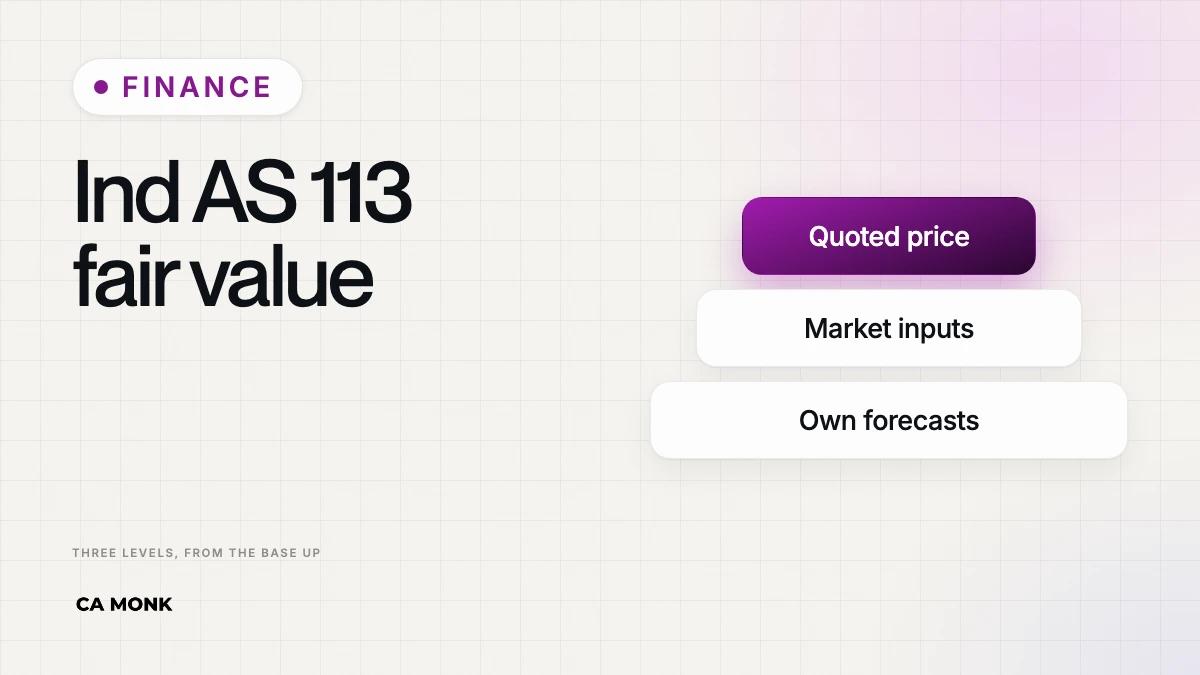
Not every figure is as solid as a share price on a stock exchange. So the standard ranks each fair value by how much of it was seen in a market and how much was estimated (fair value hierarchy).
Brightpath also paid ₹2,00,000 for a small stake in a young, unlisted online-learning company. Nobody trades these shares. A valuer builds a model from interest rates seen in the market and from a guess at how fast the start-up will grow. Say the model gives ₹2,50,000. Most of the inputs can be seen, but the growth guess drives the answer. When one guessed input matters this much to the result, the whole figure is placed at the level of that input. So this ₹2,50,000 is Level 3, not Level 2.
At the end of the year, Brightpath records its listed shares at ₹5,00,000 (Level 1) and its start-up stake at ₹2,50,000 (Level 3).
The standard does not apply to everything that sounds like "value". It does not cover payments to staff in the form of shares, or leases. Nor does it cover figures that resemble fair value but are not, such as what stock in a shop will sell for after selling costs, or what an asset is worth to the company that keeps using it.
Three slips are common:
Accountants meet fair value most often with investments, such as shares, bonds and loans. When there is a market price they use it, and when there is none they need a valuation model. When one company buys another, each asset and debt it takes over is valued at fair value on the day of the purchase. So finance teams and auditors need valuations they can support with evidence.
For Level 3 figures that come up every year, the company must explain in its accounts how the figure moved from start to end of year. It must also give the main guesses used, and how much the figure would change if they were different. Auditors check both the model and those explanations.
No. It is what you would get if you sold today. Brightpath paid ₹4,00,000 for its shares, but on 31 March they would sell for ₹5,00,000. The ₹5,00,000 is the fair value.
No. Fair value is the price itself, before any costs of selling. If Brightpath's shares sell for ₹5,00,000 and the broker charges ₹5,000, the fair value is still ₹5,00,000. The ₹5,000 is a cost of selling, not part of what the shares are worth.
Because fair value is what buyers would pay, and buyers pay for the best allowed use. Brightpath's car park is worth ₹40,00,000 as parking, but buyers would pay ₹60,00,000 to build shops there. So its fair value is ₹60,00,000, whatever Brightpath plans to do.
If you want to read more about Indian accounting standards, these pages are a good next step.
Ind AS Masterclass
Understand IND AS applicability, who must adopt it, compliance thresholds, reporting requirements, and penalties for non-compliance.