Article Topics
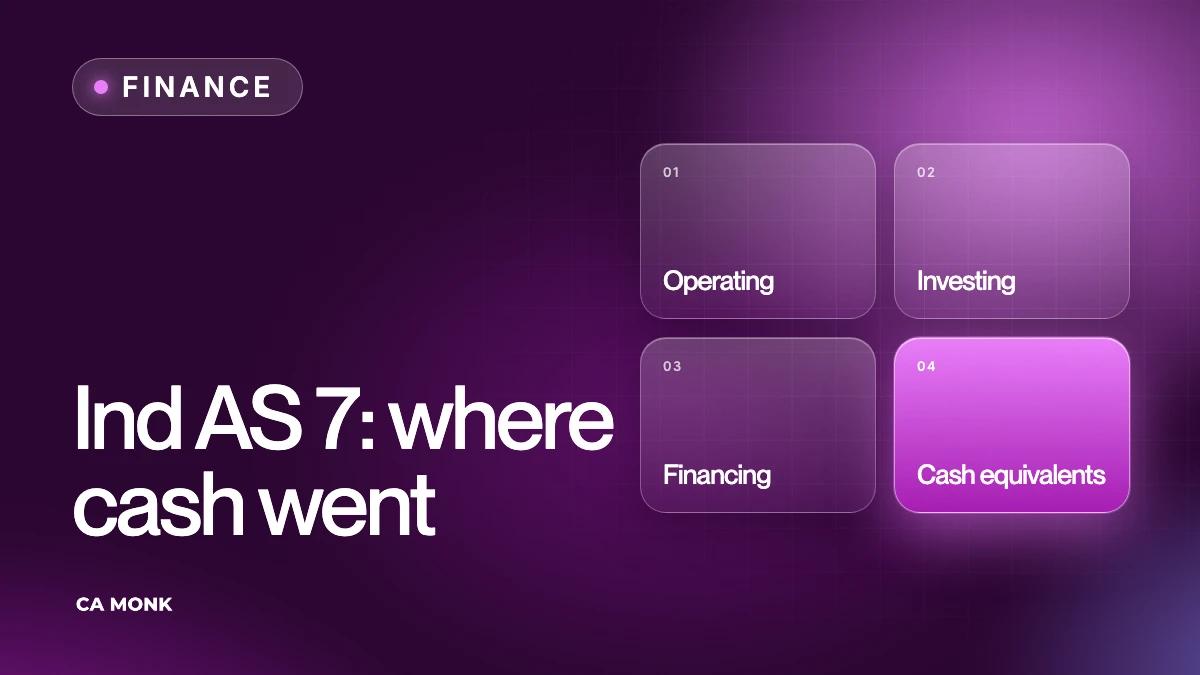
A company can make a good profit and still run short of money in the bank. Ind AS 7 is the Indian accounting standard that makes a company show, every year, where its cash actually came from and where it went, in one table: the cash flow statement.
This table sorts every rupee in and out into three groups: running the business, buying and selling long-term things, and raising or repaying money. A company has to include this table with its accounts for every year it reports on. Its purpose is to let a reader judge whether the business can pay its bills on time and how it is funded.
Say Golden Crust is a small bakery company. In its first full year, its accounts show a profit of ₹3,00,000. Yet the money it held in its till and bank went from ₹50,000 at the start of the year to ₹2,00,000 at the end. That is a rise of ₹1,50,000, half the profit. The cash flow statement explains the gap, line by line.
Money from running the bakery. This is the money that comes from selling bread and cakes and paying for flour, staff and rent (operating activities). The simplest way to see it is to list what actually came in and went out. During the year, customers paid Golden Crust ₹12,00,000. The bakery paid ₹6,00,000 to its flour and packaging suppliers, ₹2,40,000 in wages to its staff and ₹30,000 in rent to its landlord. Take all the payments away from what customers paid: ₹12,00,000 − ₹6,00,000 − ₹2,40,000 − ₹30,000 = ₹3,30,000. Listing receipts and payments like this is the first of the two ways the standard allows.
Most companies use the second way, which starts from the profit and corrects it (indirect method). The idea is that profit counts some things that never moved cash, and misses some cash that did move. So:
The sum is ₹3,00,000 + ₹50,000 + ₹30,000 − ₹40,000 − ₹20,000 + ₹10,000 = ₹3,30,000. Both ways give the same answer, as they must.
Money spent on long-term things. This group covers buying and selling things the business keeps for years, such as machines, and investments (investing activities). Golden Crust paid ₹2,00,000 to an equipment dealer for a new oven. It also put ₹1,00,000 into a one-year fixed deposit with its bank. Together that is ₹3,00,000 going out.
Money raised or repaid. This group covers money from lenders and shareholders, and what is paid back to them (financing activities). The bank lent Golden Crust ₹1,50,000 during the year, and the bakery paid the bank ₹30,000 in interest. That is ₹1,50,000 − ₹30,000 = ₹1,20,000 coming in.
Putting it together. Add the money from running the bakery and the money raised, then take away what was spent on long-term things: ₹3,30,000 + ₹1,20,000 − ₹3,00,000 = ₹1,50,000. Add that to the ₹50,000 the bakery started with, and you get the ₹2,00,000 it ended with. So Golden Crust records, in its cash flow statement for the year, ₹3,30,000 from running the bakery, ₹3,00,000 spent on long-term things and ₹1,20,000 raised.
"Cash" here means notes and coins in hand and money in bank accounts that can be withdrawn at any time. Next to it sit short-term investments that can be turned into a known amount of cash quickly, with almost no risk of their value moving (cash equivalents). Usually this means something due to be repaid within about three months of the day it was bought.
Golden Crust's ₹2,00,000 at year end is made up of ₹1,40,000 in its till and current account, plus a 60-day bank deposit of ₹60,000. The 60-day deposit counts as cash. The one-year deposit of ₹1,00,000 does not, which is why it appeared as money spent on investments. Had the bakery wrongly counted both deposits as cash, it would have shown ₹3,00,000 of cash at year end and only ₹2,00,000 spent on investments.
A few placements trip people up:
Every routine payment or receipt has to land in one of the three groups: money from customers, payments to suppliers and staff, spending on machines, buying and selling investments, loans taken and repaid, and shares issued. An accountant preparing the statement makes that call for each one.
An auditor checking it asks a short list of questions. Do the short-term deposits really count as cash? Is the overdraft truly part of daily cash handling? Are interest, dividends and tax placed the way the Indian standard says?
Profit counts sales when they are made, not when the money arrives, and it counts the cost of things like ovens slowly over years. If Golden Crust sells ₹40,000 of cakes on credit and buys a ₹2,00,000 oven, its profit can look healthy while its bank balance falls. The cash flow statement shows exactly that gap.
Only if it is short, usually due within about three months from the day it was made, and safe in value. Golden Crust's 60-day deposit of ₹60,000 counts as cash. Its one-year deposit of ₹1,00,000 does not, so it is shown as money spent on investments.
For an ordinary company in India, interest paid goes with raising and repaying money. Golden Crust paid ₹30,000 interest on its bank loan, so it sits beside the ₹1,50,000 loan received, not with money from selling bread. Interest the bakery earns on its deposits would go with investments instead.
If you want to read more about Indian accounting standards, these pages are a good next step.
Ind AS Masterclass

CA MONK Team
CA Career & Learning Platform
CA MONK Team is the team behind CA Monk, India's CA career and learning platform. We help Chartered Accountants and CA aspirants build skills, explore career opportunities, connect with mentors, and navigate their professional journey through courses, mentorship, career tools, placements, and practical industry insights.
What does CA do in India? Learn the real roles, duties, and scope of CA work. Simple and student-friendly guide.