Article Topics
Ind AS 8 is the rule that says how a company picks its recording methods (accounting policies), when it may change them, and what it does when a guess changes or an old mistake turns up. Its aim is simple: a reader should be able to set this year's figures beside last year's, or beside another company's, and compare like with like.
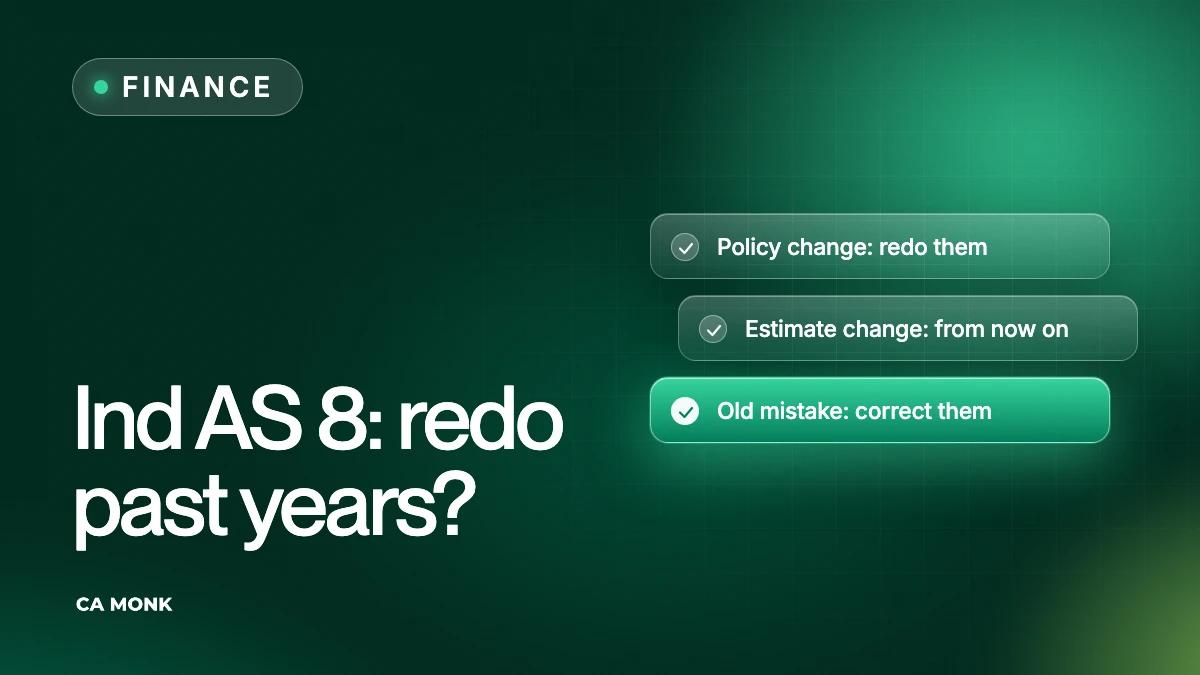
Every business that keeps accounts makes choices about how to record things, makes guesses about the future, and now and then makes mistakes. The rule sorts every change into one of three kinds, and each kind is handled differently:
Take a gym in Pune, run as a company that follows Ind AS. Some years ago it bought treadmills for ₹10,00,000. It expected them to last 10 years. So each year it records a share of their cost as an expense, called depreciation. Spreading ₹10,00,000 evenly over 10 years means dividing by 10: ₹1,00,000 a year. After four years, ₹4,00,000 of the cost has been charged, and the treadmills stand in the accounts at ₹10,00,000 minus ₹4,00,000, which is ₹6,00,000.
Now the gym is closing its accounts for this year. Its accounts show this year's figures with last year's beside them. Last year's profit was reported as ₹5,00,000. Three things come up during the close.
First, the gym checks it is using the right methods. Where a standard deals with an item, the gym must record it the way that standard says. Where no standard covers it, the management uses its judgment to pick a method that gives useful, reliable figures. It looks first at standards on similar matters, then at the general principles behind all the standards. Whatever method it picks, it must use the same one for all similar items, year after year.
Second, a guess changes. The treadmills are used far more than expected. An engineer now says they will last only 3 more years, not 6. This is new information, so it is an updated guess, not a mistake. The gym does not touch the four earlier years. It simply spreads what is left over the time that is left. To find the new yearly charge, divide the remaining ₹6,00,000 by the 3 years left: ₹2,00,000 a year. So this year, and each of the next two years, the gym records ₹2,00,000 of depreciation instead of ₹1,00,000. Handling a change only from now on, with past years left alone, is called applying it prospectively.
Third, an old mistake turns up. Last year's electricity bill was ₹1,00,000, but the accountant entered it as ₹10,000. The bill was in hand when last year's accounts were approved, so this is a mistake, not new information. Last year's expenses were understated by ₹1,00,000 minus ₹10,000, which is ₹90,000. So last year's true profit was ₹5,00,000 minus ₹90,000: ₹4,10,000.
The gym does not push this ₹90,000 into this year's profit, because the cost belonged to last year. Instead, in the first accounts it approves after finding the mistake, it shows last year's figures again, corrected, as if the mistake had never happened. Last year's column now shows a profit of ₹4,10,000. Had the mistake been from a year older than any year shown in the accounts, the gym would instead correct the opening balances of the earliest year shown.
Fourth, the gym changes a method. The gym also sells protein bars and shakes. It decides to change the method it uses to put a value on unsold stock. It may do this only because the new method gives reliable and more useful information. A company may also change a method when a new standard requires it; then it follows whatever the new standard says about the switch. A voluntary change like this one is applied as if the new method had always been used (applied retrospectively). Worked out under the new method, last year's profit comes out ₹20,000 lower. So last year's profit is shown again once more: ₹4,10,000 minus ₹20,000, which is ₹3,90,000.
At the end of the close, the gym records ₹2,00,000 of treadmill depreciation this year. Its accounts show last year's profit as ₹3,90,000, not the ₹5,00,000 it first reported. The ₹1,10,000 gap is the ₹90,000 mistake plus the ₹20,000 from the method change.
The hard part is deciding which kind of change something is. That one decision settles whether earlier years are redone or left alone.
Suppose the gym had treated the shorter treadmill life as a mistake. It would have redone four years of depreciation for no reason. Expected life of equipment is a guess, and guesses get updated as facts come in. The same goes for how much customers will fail to pay and what an asset would fetch if sold today. Updating these is not a change of method.
The test between a mistake and a changed guess is what was known at the time. If the information was available, or could reasonably have been obtained, when the earlier accounts were approved, and it was missed or misused, that is a mistake. If it is truly new, it is a changed guess. Mistakes can come from wrong arithmetic, applying a method wrongly, overlooking or misreading facts, and fraud.
An accountant at an Ind AS company uses this standard whenever a deal comes up that no standard covers, so a method has to be set. It also comes up at every year-end, when guesses such as asset lives, unpaid customer dues and fair values are looked at again. And it decides what happens when an old misstatement is found before the accounts go out.
Auditors check the same three things: that methods are used consistently, that each change is put in the right kind, and that earlier figures are redone where they should be. The tax side of a correction is handled by a different standard, Ind AS 12.
No. Last year's figures are shown again, corrected, as if the mistake never happened. Say last year's rent of ₹60,000 was left out entirely. Last year's profit is shown ₹60,000 lower in this year's accounts. This year's own profit is not charged with that ₹60,000.
No. It may switch only if a standard requires it, or if the new method gives reliable and more useful information. A switch made just to show a higher profit this year does not qualify. And once it switches by choice, earlier years are redone under the new method, so the comparison stays fair.
No. That is a changed guess, so only this year and later years are affected. Say the gym expected ₹30,000 of membership fees to go unpaid and now expects ₹50,000. It records the extra ₹20,000 as an expense this year. Last year's figures stay as they were.
If you want to go further into how Ind AS companies prepare their accounts, these pieces are a good next read.
Ind AS Masterclass

CA MONK Team
CA Career & Learning Platform
CA MONK Team is the team behind CA Monk, India's CA career and learning platform. We help Chartered Accountants and CA aspirants build skills, explore career opportunities, connect with mentors, and navigate their professional journey through courses, mentorship, career tools, placements, and practical industry insights.
Learn IND AS 109 & 107 essentials, exam-ready clarity, and the latest NFRA updates effective April 2026—all in one place.