6 min read 19 Nov 2026
Ind AS applicability explained simply: who must follow them and when
CA MONK Team
Article Topics
India's newer rulebook for company accounts is called the Indian Accounting Standards (Ind AS), and it applies to larger companies and the companies linked to them. Ind AS applicability is the question of which companies must follow it, and from which year.
Every company keeps accounts: what it earned, what it spent, what it owns and what it owes. Accounting standards are the rulebook for how those figures are worked out and shown, so that two companies' accounts can be read the same way.
The Companies Act, 2013 lets the Central Government set accounting rules for companies, after asking an advisory body for its view. The Ministry of Corporate Affairs then issued Ind AS through the Companies (Indian Accounting Standards) Rules, 2015. Companies the Ind AS dates do not catch keep using India's older rulebook (Accounting Standards).
Ind AS were built to sit close to the rules used in many other countries (IFRS). They were not copied word for word: India kept some changes to suit its own conditions.
Meet Sunrise Bakes Private Limited, a company that runs a chain of bakeries in several cities. Its shares are not bought and sold on any stock exchange. Its accounting year runs from 1 April to 31 March.
The question for Sunrise is simple: does it have to use Ind AS, and from which year? The answer depends on its size, measured as what the company owns minus what it owes (net worth).
Sunrise owns shops, ovens, stock and cash worth ₹900 crore. It owes ₹600 crore to banks and suppliers. To find its net worth, take what it owes away from what it owns: ₹900 crore minus ₹600 crore is ₹300 crore.
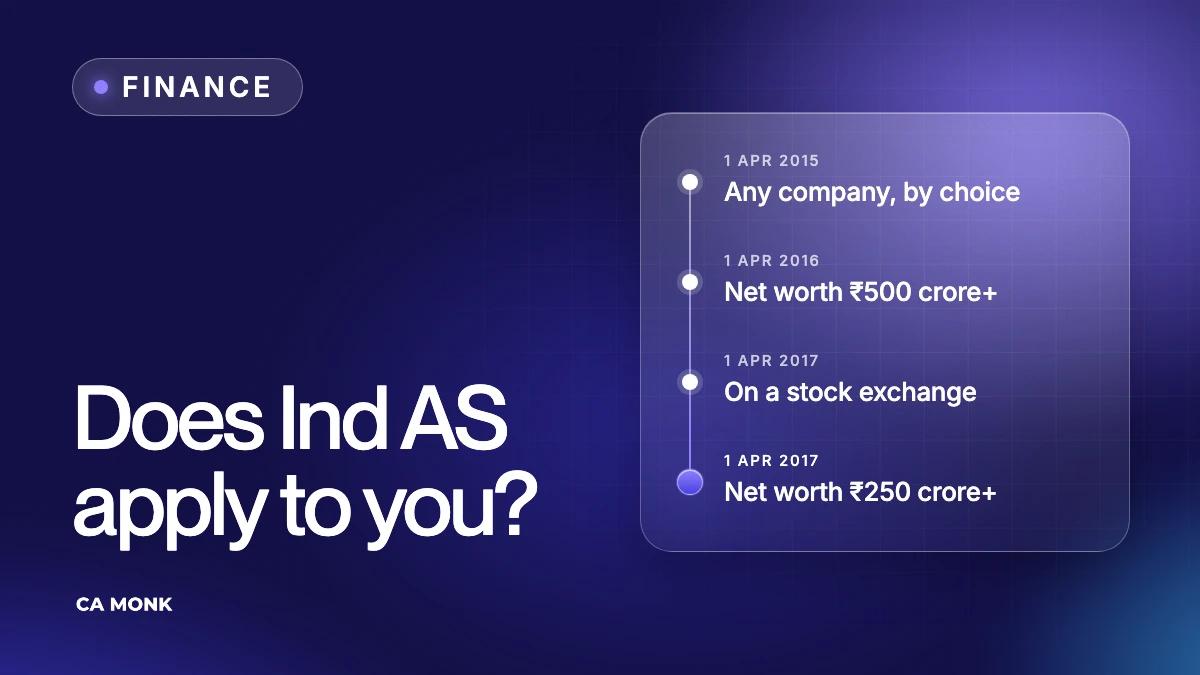
Now Sunrise checks that figure against the dates the government set:
So Sunrise must prepare its accounts under Ind AS for the year from 1 April 2017 to 31 March 2018, and for every year after that.
See how the sum changes the answer. Had Sunrise owed ₹700 crore instead of ₹600 crore, its net worth would be ₹900 crore minus ₹700 crore, which is ₹200 crore. That is below ₹250 crore, so none of these dates would catch it, and it could stay on the older rulebook. Had it owed only ₹350 crore, its net worth would be ₹550 crore, and it would have had to switch a year earlier, from 1 April 2016.
The rule also reaches companies linked to a covered one. If Sunrise owned a smaller company that runs its cake deliveries, that smaller company would have to use Ind AS from the same year, whatever its own size. The same goes for a company that owns Sunrise, and for its joint ventures and the other companies it has a large stake in.
Once Sunrise starts using Ind AS, it cannot go back. Every set of accounts it prepares after that must follow Ind AS.
For its first year on the new rules, the aim is that Sunrise's accounts give clear, good-quality information, can be compared with its earlier years, give a sound base for the years that follow, and cost no more to prepare than they are worth.
Banks, insurance companies and finance companies that are not banks are left out of these dates altogether.
Compared with the older rulebook, Ind AS more often show some items at what they would sell for today (fair value) instead of what was paid for them. They also usually ask a company to explain more in the notes to its accounts.
The biggest changes tend to come in three places: when a sale counts as revenue, how rented shops and equipment are recorded, and how loans, investments and similar items are recorded. For a chain like Sunrise, which rents most of its shops, the way it records those rents is likely to change. Companies in manufacturing, retail, real estate, banking and financial services often see their reported figures move the most.
The figures can go wrong in a few common ways:
Sunrise's accountants decide, deal by deal, how each one should be recorded, measured and shown under the right standard, before the accounts are finished.
Its auditors then check whether the choices Sunrise made, and the notes it wrote, follow the standards. They also check whether the accounts give a true picture of what Sunrise owns, owes and earned.
Not under the dates above, unless it is linked to a covered company. Say a company running three bakeries has a net worth of ₹20 crore and its shares are not on a stock exchange. None of the dates catch it, so it keeps using the older rulebook, though it may choose Ind AS if it wishes.
No. Once a company has prepared accounts under Ind AS, every later set of accounts must follow them too. If Sunrise switched for the year to 31 March 2018, its accounts for 2019, 2020 and every year after must also follow Ind AS.
Close, but not the same. Ind AS were built to sit near the rules many other countries use, with some changes India kept for its own conditions. A foreign investor reading Sunrise's accounts will find them built on familiar lines, but should not assume every figure is worked out exactly as at home.
This post was checked against the law in November 2026. Laws change, so read the official text before you act on it.
To see how individual standards work in practice, these posts take them one at a time.
Ind AS Masterclass
Ind AS Masterclass

CA MONK Team
CA Career & Learning Platform
CA MONK Team is the team behind CA Monk, India's CA career and learning platform. We help Chartered Accountants and CA aspirants build skills, explore career opportunities, connect with mentors, and navigate their professional journey through courses, mentorship, career tools, placements, and practical industry insights.
Discover the top CA firms in India beyond the Big 6, offering expert services across major cities. Find the right firm today!


