Article Topics
India's accounting standards, known as Ind AS, are detailed rules for how a business writes up its accounts. The Ind AS conceptual framework is the shorter document of ideas behind those rules: who the accounts are for, what makes a figure in them useful, and what counts as something the business owns or owes.
The framework is not one of the rules itself. The people who write the standards use it to shape them. Accountants lean on it to choose a method when no rule fits a deal. Accountants, auditors and other readers use it to understand what a rule means.
Take Raj, who runs a gym as a small company that follows Ind AS. On 1 October, 100 members each pay the gym ₹12,000 in advance for a year of workouts. That puts ₹12,00,000 in the gym's bank account. The gym's year ends on 31 March, and over those six months it spends ₹4,00,000 on rent, trainers and electricity.
Raj wants to show all the money members paid as this year's income. His figure takes the costs away from everything members paid:
₹12,00,000 − ₹4,00,000 = ₹8,00,000 profit
He plans to show that profit to his bank, because he wants a loan for new machines. The framework's ideas give a different answer, as the story below shows.
The framework starts with a question: who reads accounts, and why? Its answer is the people who might put money into the business or lend to it, today or later, and who are deciding whether to do so. Here, that is Raj's bank, deciding on the loan.
For a figure to help that reader, the framework asks for two things.
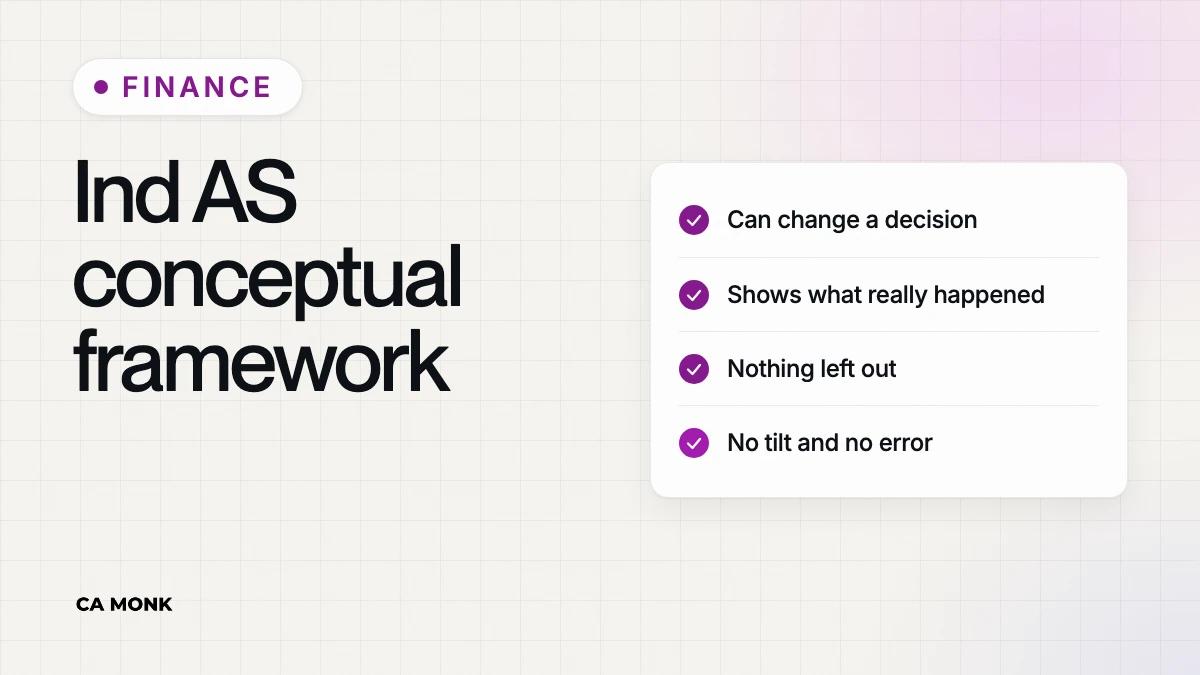
First, the figure must be able to change the reader's decision (relevance). It can do that by helping the reader guess what comes next, by checking an earlier guess, or both. Here, the bank uses the gym's profit to judge whether the gym can repay a loan.
Second, the figure must show what really happened (faithful representation). That means nothing left out, no tilt towards a hoped-for answer, and no error. Here, Raj's ₹8,00,000 fails this test: it leaves out something the gym still has to do.
The framework also names four qualities that make good figures better: they can be compared with other years and other businesses, someone else can check them, they arrive in time to be used, and a reader can understand them.
The framework describes five building blocks of a business's accounts: what it owns, what it owes, what is left for the owners, what comes in and what goes out. Two of them settle Raj's case.
Something the business controls because of something that already happened, and that brings it value, is something it owns (asset). Here, the ₹12,00,000 in the bank is the gym's, because members have already paid it.
A duty the business has today, because of something that already happened, and that will cost it something to meet, is something it owes (liability). Here, members paid for twelve months, and by 31 March the gym has given only six. It still has to give six months of workouts to people who have already paid. That duty came from taking their money, and meeting it will cost the gym trainers, rent and electricity.
So the accountant splits the ₹12,00,000 into the part earned and the part still owed. The money was paid for twelve months, so first she finds what one month is worth by dividing by twelve:
₹12,00,000 ÷ 12 = ₹1,00,000 a month
The gym has given six of those months, so she multiplies by six to find what it has earned:
₹1,00,000 × 6 = ₹6,00,000
The rest is what the gym still owes in workouts. She takes the earned part away from the total paid:
₹12,00,000 − ₹6,00,000 = ₹6,00,000
Now the profit is the earned income less the same costs:
₹6,00,000 − ₹4,00,000 = ₹2,00,000
So on 31 March the gym records income of ₹6,00,000, a profit of ₹2,00,000, and ₹6,00,000 owed to members as workouts still to be given. The bank sees a profit of ₹2,00,000, not ₹8,00,000. Both figures meet the two tests: they could change the bank's decision, and they show what really happened.
Ind AS also has its own detailed standard for income from customers. This example uses only the framework's ideas, to show why the answer comes out as it does.
Sometimes a business meets a deal that no specific Ind AS covers. Then the people who run it must use their judgement to settle on a method of recording it (accounting policy). That method must still give figures that pass the two tests: able to change a decision, and true to what happened. The search runs in this order:
The most common mistake is to treat the framework as a rule that beats the standards. It does not. Where the framework and a specific Ind AS point different ways, the specific Ind AS wins. The framework does not replace any standard's own rules.
The second mistake is to mix up the two must-haves with the four qualities that only make figures better. A figure that can be compared with last year but leaves out a debt is still a wrong figure. Being able to change a decision, and being true to what happened, come first.
The specific rule. The framework guides how rules are written and read, but it does not override them. Say Raj's accountant reads the framework one way for a deal, and the Ind AS written for that deal sets out a different method. The gym records the deal by the Ind AS method, even if the framework seemed to suggest otherwise.
No. It must also be able to change a reader's decision, and it must show the whole picture. The gym's exact ₹8,00,000 profit was worked out without error, yet it left out ₹6,00,000 of workouts still owed to members. A bank deciding on a loan would have been misled by a figure that was exact but incomplete.
Not by itself. The cash belongs to the business, but it also owes the customer the service. Say one member pays the gym ₹12,000 on 1 October for a year. By 31 March the gym has earned ₹6,000 for six months given, and still owes ₹6,000 worth of workouts for the six months to come.
These posts look more closely at the ideas and standards that shape a business's accounts.
Ind AS Masterclass

CA MONK Team
CA Career & Learning Platform
CA MONK Team is the team behind CA Monk, India's CA career and learning platform. We help Chartered Accountants and CA aspirants build skills, explore career opportunities, connect with mentors, and navigate their professional journey through courses, mentorship, career tools, placements, and practical industry insights.
Explore Top CA Articleship Firms for unparalleled opportunities. Your gateway to excellence in finance awaits!