6 min read 26 Nov 2026
Place of supply under GST explained simply: which state gets the tax
CA MONK Team
Article Topics
Place of supply under GST is the rule that decides where a sale "happens", and so which kind of GST a business charges. If the sale happens within one state, the bill carries two equal halves: one for the Central Government (CGST) and one for that state (SGST). If the sale crosses a state line, the bill carries one tax, IGST, equal to the two halves added together.
So the place of supply does not usually change how much GST the customer pays. It changes which government the tax goes to. A business that gets it wrong pays the right amount into the wrong account, and has to put it right.
Meet Priya, who runs Nest Studio, an interior design studio in Pune, Maharashtra. In March she did four jobs:
Say the GST rate on all her work is 18%. The amount of GST is the same whichever kind it is: for the café, 18% of ₹2,00,000 is ₹36,000. What the place of supply decides is whether that ₹36,000 is split into CGST and SGST, or charged whole as IGST.
The rules sit in the Integrated GST Act, 2017, in sections 10 to 13. Since Priya and all her customers are in India, the rules for her work are in section 12. Once she knows the place of supply, she compares it with where her own studio is:
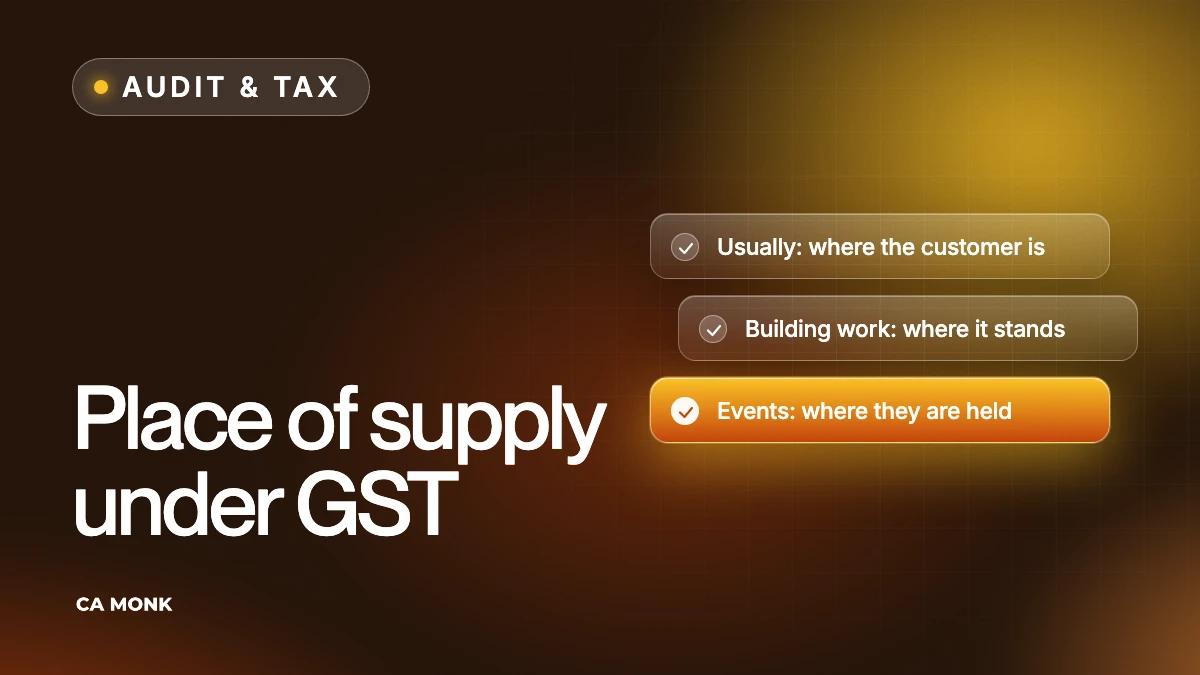
The usual rule: where the customer is. For most services, the place of supply is where the customer is located. The Delhi bakery is in Delhi, so the logo job's place of supply is Delhi. Pune and Delhi are in different states, so Priya charges IGST: 18% of ₹1,00,000 = ₹18,000.
Work on a building: where the building is. For services connected with land or a building, the place of supply is where the property stands, not where the customer lives. The café is in Pune, so that job stays in Maharashtra. Priya charges ₹36,000, split equally: ₹18,000 CGST and ₹18,000 SGST.
The Goa flat is the job where this rule changes the answer. Her client lives in Pune, so by the usual rule the job would stay within Maharashtra. But the work is on a flat that stands in Goa, so the place of supply is Goa. Pune and Goa are in different states. Priya works out 18% of ₹3,00,000, which is ₹54,000, and charges it all as IGST.
Entry to an event: where the event is held. For tickets to an event, the place of supply is where the event actually takes place. First Priya works out what the tickets brought in: 50 × ₹2,000 = ₹1,00,000. The workshop was held in Bengaluru, so the place of supply is Karnataka, a different state from her studio. She charges IGST of 18% of ₹1,00,000 = ₹18,000.
Now Priya adds up March. The GST on all four jobs is ₹36,000 + ₹54,000 + ₹18,000 + ₹18,000 = ₹1,26,000. Of that, ₹18,000 is CGST and ₹18,000 is SGST, both from the café. The other ₹54,000 + ₹18,000 + ₹18,000 = ₹90,000 is IGST. That is what she reports and pays for March.
An easy slip is the one Priya almost made with the Goa flat: looking only at where the customer lives. Had she done that, she would have charged ₹27,000 CGST and ₹27,000 SGST on that job. The customer pays the same ₹54,000 either way, so nobody notices at once.
But the tax went into the wrong accounts. When this comes to light, she has to pay the ₹54,000 again, this time as IGST. She then claims back the ₹54,000 of CGST and SGST she paid by mistake as a refund. Until the refund arrives, the same tax has been paid twice from her bank account.
A few more kinds of work have their own rule, each picking the place where the thing really happens:
When either the business or its customer is outside India, a separate set of rules in section 13 applies. Some match the ones above: work on a building still goes by where the building is. Others are new: for passenger transport, it is where the passenger boards for a continuous journey, and for a phone or internet line, it is where the line is installed.
Usually not. A ₹1,00,000 job at 18% carries ₹18,000 of GST either way. Within one state it is ₹9,000 CGST plus ₹9,000 SGST. Across states it is ₹18,000 IGST. What changes is which government receives it.
For work on a building, go by where the building is. A Mumbai architect designing a house in Indore for a Mumbai client has the place of supply in Madhya Pradesh. Mumbai is in Maharashtra, so the architect charges IGST.
For entry to an event, the place of supply is where the event is held: Telangana here. Your company is in Tamil Nadu, a different state, so you charge IGST on the tickets. Say you sold ₹5,00,000 of tickets and the rate is 18%: that is ₹90,000 of IGST.
These posts explain the GST questions that come before and after deciding the place of supply.

CA MONK Team
CA Career & Learning Platform
CA MONK Team is the team behind CA Monk, India's CA career and learning platform. We help Chartered Accountants and CA aspirants build skills, explore career opportunities, connect with mentors, and navigate their professional journey through courses, mentorship, career tools, placements, and practical industry insights.
Section 65 GST Audit Explained: Notice, Timelines, Rule 101, Penalties, and CA Tips. Learn how to prepare effectively.


