Article Topics
Risk management is a habit of asking, in an orderly way, "what could go wrong here, how bad would it be, and what do we do about it now?" In the risk management process, a business lists the things that could stop it reaching its goals, decides which matter most, and acts on those first. Then it keeps checking that what it did is working.
Take a made-up bakery, Daily Bread, run by Suresh. It bakes bread and cakes in one kitchen and sells about ₹60,00,000 a year, partly over its own counter and partly to cafés nearby that pay at the end of each month. One big oven does most of the baking.
Suresh's goal for the year is simple: keep baking every day, and get paid for what he sells. Risk management is how he protects that goal.
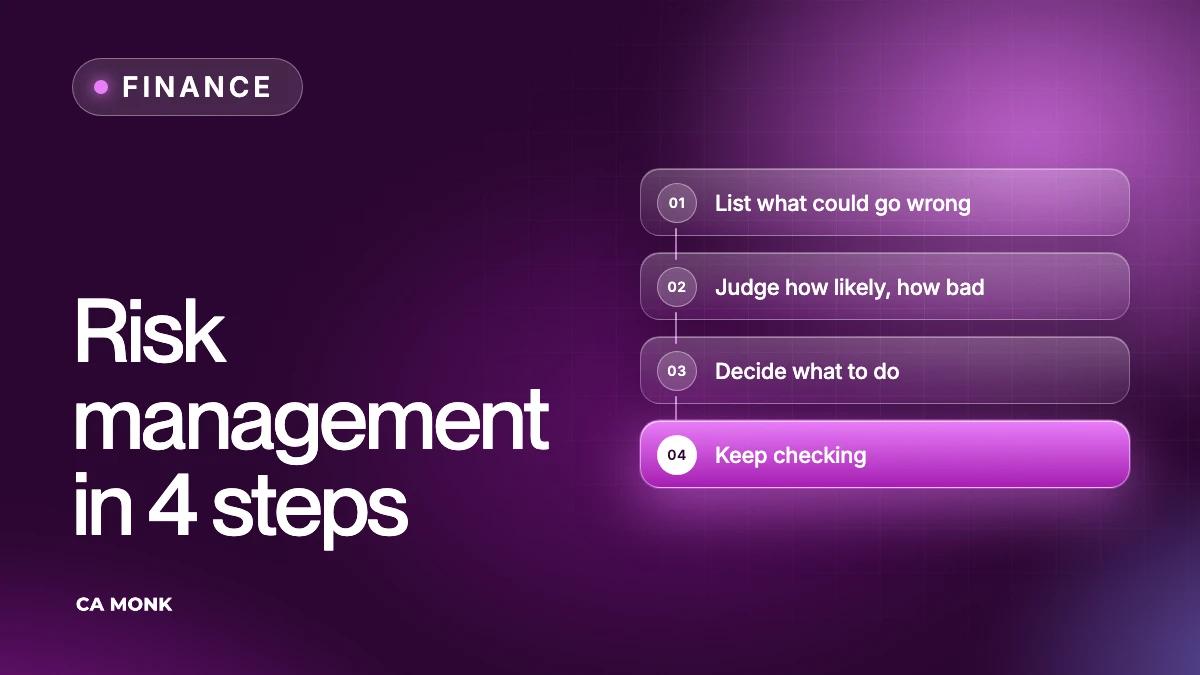
The work follows four steps, in order:
The list itself, with the scores, what is being done and who is in charge of each item, is kept in one place (a risk register).
One simple way to rank the risks is to multiply the two scores. A risk that is both likely and painful rises to the top.
The oven comes first. Suresh puts a figure on it. If it breaks, a repair takes about five days, and the bakery loses about ₹20,000 of sales a day. Five days at ₹20,000 is ₹1,00,000 of lost sales. A yearly service contract that catches problems early costs ₹15,000. Spending ₹15,000 to make a ₹1,00,000 loss much less likely is an easy call.
There are four broad ways to respond to a risk, and Daily Bread ends up using all of them.
Make it smaller. The oven service contract makes a breakdown less likely. For the licence, Suresh puts the renewal date in the manager's calendar two months ahead. For the café chain, he decides that no single customer may owe him more than ₹3,00,000 at a time, and asks the chain to pay every two weeks instead of monthly.
Pass it to someone else. For flour, Suresh agrees a fixed price for the year with his mill. If flour prices rise, the mill carries that cost, not the bakery.
Stay away from it. A hotel offers Daily Bread a large order, paid 120 days after delivery. Suresh would have to borrow to buy the extra flour and wait four months for his money. He turns it down.
Live with it. A few loaves go stale every evening. The loss is small and checking it would cost more than it saves, so Suresh accepts it.
Behind these choices is a limit Suresh has set for himself: how much he is willing to risk to grow (risk appetite). His ₹3,00,000 cap on what one customer may owe is that limit in rupees. A bolder owner might set it at ₹6,00,000, and a careful one at ₹1,00,000.
The first mistake is keeping the list for show. A risk register that is filled in once a year for an inspector, and never opened when a decision is made, protects nothing. Daily Bread's list earns its keep when the hotel order arrives and Suresh checks it against his ₹3,00,000 limit.
The second is naming risks without naming who handles them. "The oven might break" with no name beside it means nobody arranges the service. At Daily Bread, the manager owns the oven and the licence, and Suresh owns the customer limits.
At work, risk management shows up in the everyday checks a business builds into its routines (internal controls), such as two signatures on a large payment or a monthly check of who owes what. Internal auditors decide where to spend their time by looking at where the biggest risks are and how good the checks around them are. They then report whether those checks are good enough. In a bank, the same thinking is split into named kinds of risk: borrowers not paying, prices and rates moving, cash running short, things going wrong in daily operations, and legal trouble.
No. Insurance is one way of passing a risk to someone else. Many risks are handled other ways: a ₹15,000 oven service contract makes a ₹1,00,000 breakdown less likely, a cap on customer credit limits a bad debt, and some small losses are simply accepted.
Score each risk on how likely it is and how badly it would hurt, then multiply. A risk scoring 3 for likelihood and 4 for harm, which is 12, comes before one scoring 1 and 5, which is 5. Deal with the highest scores first, then work down.
No. Every business takes risks to earn money. The owner decides how much risk is acceptable, such as letting no customer owe more than ₹3,00,000, and acts only where a risk goes past that. A few stale loaves a day can simply be lived with.
If you want to go further into how businesses measure and manage financial risk, these posts are a good next read.

CA MONK Team
CA Career & Learning Platform
CA MONK Team is the team behind CA Monk, India's CA career and learning platform. We help Chartered Accountants and CA aspirants build skills, explore career opportunities, connect with mentors, and navigate their professional journey through courses, mentorship, career tools, placements, and practical industry insights.
What does CA do in India? Learn the real roles, duties, and scope of CA work. Simple and student-friendly guide.