6 min read 24 Nov 2026
SA 200 overall objectives: what an auditor checks and promises
CA MONK Team
Article Topics
In India, the rules for how every audit of accounts works start with one standard, SA 200. It sets out the auditor's overall objectives, meaning what the auditor is trying to achieve, and the attitude the auditor must bring to the job. It applies to the audit of a small private company as much as to a bank or a charity.
A business writes up its own accounts each year: what it earned, what it spent, what it owns and what it owes. An auditor is an outside accountant who checks those accounts and says, in a signed report, whether they can be trusted. People such as the company's bank and its shareholders read that report.
Meet Sunita. She owns FitZone, a gym in Nagpur run as a private company. FitZone earns from yearly memberships at ₹12,000 a head and from a few corporate deals, where a nearby office pays for its staff to train there. This year FitZone's accounts show income of ₹60,00,000. The company has appointed Mr Rao, a Chartered Accountant, as its auditor.
The first point people miss is who is responsible for the accounts. It is Sunita's team, not the auditor. SA 200 is clear that the business's own management prepares the accounts. It also sets up the checks that stop mistakes getting into them, such as a second person approving each refund. An audit does not take that job off management's hands.
Mr Rao's job is narrower. He must form a view on whether the accounts, taken as a whole, contain an error big enough to mislead someone reading them, whether by honest mistake or by fraud (material misstatement). Then he must report that view.
Before he starts, he must be independent of FitZone. SA 200 requires the auditor to follow the profession's ethical rules, including independence.
Next, Mr Rao decides how big an error must be to matter. Say he judges that anything of ₹3,00,000 or more would change how a bank or a shareholder reads FitZone's accounts. Smaller slips he can live with. Larger ones he will raise with Sunita.
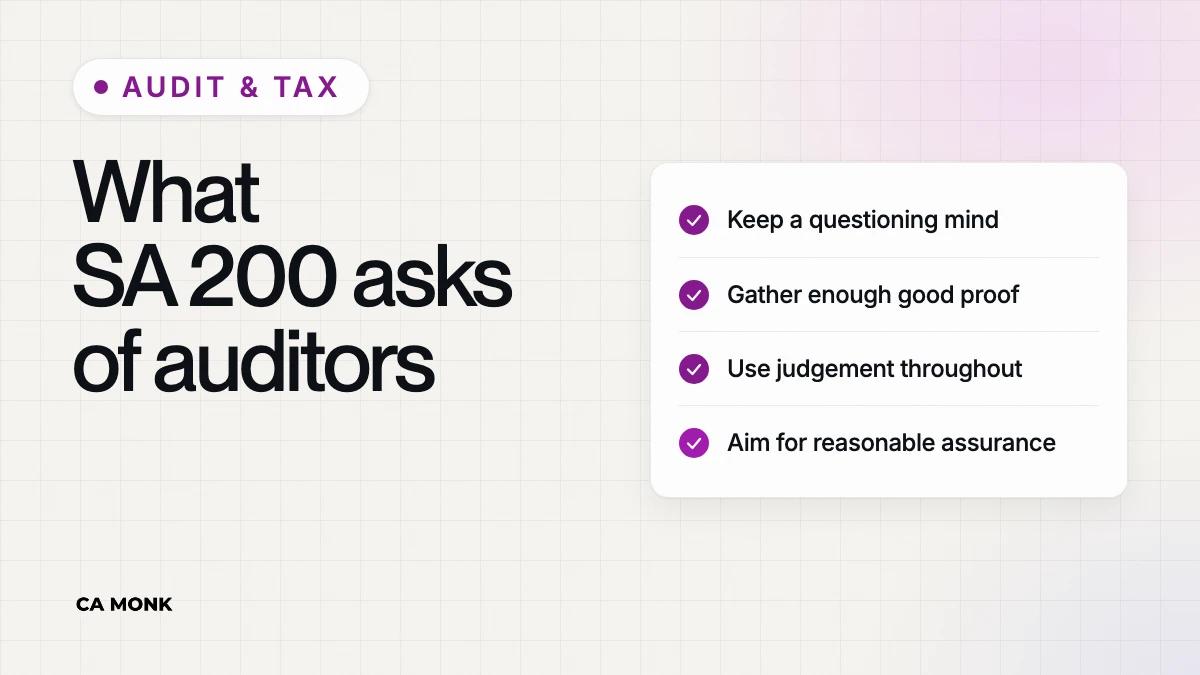
He keeps an open, questioning mind. SA 200 asks the auditor to stay alert to signs that something may be wrong and to weigh every piece of proof critically (professional skepticism). This does not mean assuming Sunita is dishonest. It means not accepting a figure just because it is in the books.
He gathers proof. The proof an auditor collects is his evidence (audit evidence). He needs enough of it, and it must be good: relevant to the question, and reliable.
FitZone's income is made up like this. There are 400 members paying ₹12,000 each, which is 400 × ₹12,000 = ₹48,00,000. Corporate deals make up the rest: ₹60,00,000 − ₹48,00,000 = ₹12,00,000.
Mr Rao matches the membership income to the gym's entry records and bank receipts. They agree.
The corporate side looks less certain. FitZone's books say one office, Pinnacle Offices, still owes ₹5,00,000 for the year. Sunita's word on this is weak proof. A letter from Pinnacle itself is stronger. So Mr Rao writes to Pinnacle and asks how much it owes. Pinnacle replies that it cancelled half-way through the year and owes only ₹1,00,000.
That gap is ₹5,00,000 − ₹1,00,000 = ₹4,00,000 of income that was never really earned. It is above his ₹3,00,000 line, so it matters.
He uses his judgement throughout. SA 200 also requires the auditor to use professional judgement at every stage: what to check, how much proof is enough, and what a finding means. Here, his judgement told him which balance to test.
Mr Rao shows Sunita the reply. Her team corrects the accounts: income falls from ₹60,00,000 to ₹60,00,000 − ₹4,00,000 = ₹56,00,000.
He reports. With the error fixed and his other checks done, Mr Rao signs his report on FitZone's accounts showing income of ₹56,00,000.
The second thing people get wrong is what the report means. An audit is not a guarantee that every figure is exact or that every fraud has been found.
SA 200 says the auditor aims for a high level of confidence that the accounts are free of errors that matter (reasonable assurance). That is high, but it is not certainty. Mr Rao did not check every one of FitZone's thousands of receipts. He gathered enough good proof to bring the chance of missing a serious error down to a level he could accept.
Sometimes the auditor cannot get there at all. Suppose a flood had destroyed FitZone's records, and nothing could replace them. If even a report that flags particular problems would not be enough, SA 200 points the auditor to declining to give any view on the accounts (disclaimer of opinion). Where the law allows, the auditor may instead step away from the job.
These ideas are not tied to one part of the accounts. An auditor applies them while checking sales, amounts customers owe, stock, and every other figure.
For anyone who prepares accounts, the lesson from FitZone is practical. Mr Rao asked for outside proof of the balance that was easiest to get wrong. Have that kind of proof ready, and expect the questions.
Yes. The auditor seeks a high level of confidence, not certainty. Mr Rao tested FitZone's biggest risks and found the ₹4,00,000 error. A well-hidden fraud of ₹50,000 spread across small receipts could still go unnoticed.
No. It means not taking a figure on trust. When Mr Rao wrote to Pinnacle about the ₹5,00,000, he was not accusing Sunita. He wanted proof from someone outside FitZone, because that proof is stronger than the owner's word.
The business's management is responsible for its accounts, audited or not. If FitZone's books had overstated income by ₹4,00,000 and nobody caught it, that error would still be FitZone's to answer for. The audit does not move that duty to the auditor.
To see how these principles play out in the rest of an audit, these related reads are a useful next step.

CA MONK Team
CA Career & Learning Platform
CA MONK Team is the team behind CA Monk, India's CA career and learning platform. We help Chartered Accountants and CA aspirants build skills, explore career opportunities, connect with mentors, and navigate their professional journey through courses, mentorship, career tools, placements, and practical industry insights.
Section 65 GST Audit Explained: Notice, Timelines, Rule 101, Penalties, and CA Tips. Learn how to prepare effectively.


