Article Topics
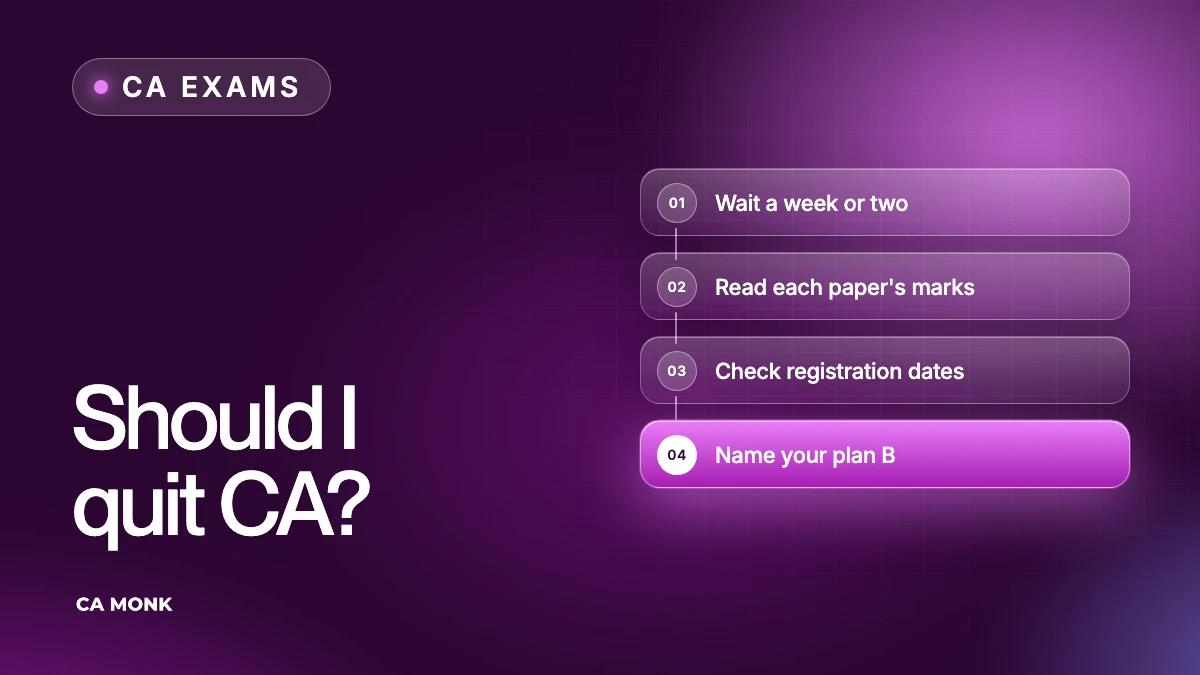
Should I quit CA? Answer that a week or two after the result, not on result day. First look at your marks in each paper, how long your registration lasts, what more attempts will cost your family, and what you would do instead. If you feel hopeless now, call the government's Tele MANAS helpline on 14416.
Last updated: 20 November 2026.
Yes. In the September 2026 exams, far more students failed than passed. ICAI declared these figures in its result notice for CA Foundation and its result notice for CA Intermediate. They are past results from one exam, not a forecast.
| September 2026 exam | Appeared | Passed | Pass rate |
|---|---|---|---|
| Foundation | 1,04,240 | 19,736 | 18.93% |
| Inter, Group I | 1,00,301 | 23,210 | 23.14% |
| Inter, both groups | 38,339 | 5,066 | 13.21% |
Why so many? To pass Foundation, ICAI's FAQs on its new scheme of education and training say you need at least 40% in each paper and 50% of the total marks, in one sitting (the same exam session). At Inter, the same rule applies to each group of papers. So one weak paper can fail a whole attempt, even when the other papers went well.
A failed attempt tells you that something went wrong in that attempt. On its own, it does not tell you that CA is wrong for you. It also helps to separate what you have heard about CA from what is true; see these common myths about the CA course. The five questions below help you tell the difference.
Wait a week or two after the result. Then sit down with a notebook and answer these in writing.
Then see which row fits your answers best:
| Your answers | A sensible next step |
|---|---|
| Narrow miss, still want CA | One more planned attempt |
| Big gap, little real study | Fix your study plan first |
| Full effort, gap not closing | Seriously consider other paths |
| Health or sleep suffering | Pause and get support |
| Interest lies elsewhere | Plan the switch, then leave |
None of these rows is a verdict. They turn a heavy feeling into a choice you can explain, to yourself and to your family.
Before you decide, check how much time your registration has left. The same ICAI FAQs say how long each registration stays valid:
| Level | Valid for | Can you extend it? |
|---|---|---|
| Foundation | 4 years | No |
| Intermediate | 5 years | Once, by 5 years, ₹400 |
| Final | 10 years | Every 10 years, ₹500 |
Foundation and Inter exams are held three times a year, in January, May and September. So skipping one attempt to rest and recover costs you a few months, not a whole year.
These rules come from an FAQ last updated on 27 September 2024. To confirm your own dates, write to ICAI's Board of Studies (BoS), which takes student queries, at [email protected].
Leaving CA does not mean leaving commerce or finance. Here are the usual paths, with a first step for each:
| Path | Suits you if | First step |
|---|---|---|
| Finish your degree | You are in college | Score well for direct entry |
| Job in accounts or tax | You enjoy accounts work | Update your CV |
| Another course or field | Your interest lies elsewhere | Talk to people in it |
| Pause, then return | Your health needs time | Note your registration dates |
Some points to keep in mind:
For many students this talk feels harder than the exam, especially when CA is a parent's dream. A few things help:
A plan, whichever way it points, is easier for a family to discuss than a feeling.
Many students feel low, numb or ashamed after a result. It does not mean you are weak or that you have failed at life. Do not make a big decision while you feel this way.
Tell one person you trust how you feel: a parent, a friend or a teacher. Sleep, eat and step outside before you think about the next attempt.
If the feeling does not lift, or you have thoughts of hurting yourself, call Tele MANAS, the Government of India's tele mental health helpline. It works 24x7. Dial the short code 14416 or the toll-free number 1800-89-14416.
Yes, if you decide calmly and have a plan B. Foundation registration is valid for four years from your first eligible attempt and cannot be revalidated, so time matters at this level. If you are doing a degree, finish it with good marks: it keeps the direct entry route to CA Intermediate open.
Often, yes. Graduates can register for CA Intermediate directly, without Foundation, if they have at least 55% marks in commerce or 60% in other subjects. An Inter registration can also be revalidated once, for five more years, for ₹400. Check your own case with ICAI's Board of Studies.
Four years from your first eligible attempt. That is how long ICAI's FAQ says a Foundation registration stays valid, and it cannot be revalidated. Exams are held in January, May and September, so count how many attempts are left in your window before you plan the next one.
Sometimes, yes. Foundation and Inter exams are held three times a year, so one skipped attempt costs months, not a year. At Foundation, your four years count from your first eligible attempt, so a break does not add time. Use the break to rest and to fix what went wrong.
Yes. Inter covers accounting, corporate law, tax, costing, audit, and financial and strategic management. After both groups and the four-week ICITSS course, you can do two years of articleship, which is practical work experience. Put both on your CV when you apply for jobs.
It is a certificate from ICAI. You can apply once you have passed both groups of Inter, completed practical training and the AICITSS course, and qualified the self-paced online modules that apply to you. Passing CA Final is not one of the conditions in ICAI's FAQ.
If you are working out your next step in CA, these posts may help.

CA MONK Team
CA Career & Learning Platform
CA MONK Team is the team behind CA Monk, India's CA career and learning platform. We help Chartered Accountants and CA aspirants build skills, explore career opportunities, connect with mentors, and navigate their professional journey through courses, mentorship, career tools, placements, and practical industry insights.
Discover how to create a strong career objective for semi-qualified Chartered Accountants (CAs), with self-evaluation tips, resume-objective examples, and career-path options across audit, taxation, consulting, corporate finance, and financial services.