5 min read 22 Nov 2026
Strategic cost management explained simply: costs that serve your plan
CA MONK Team
Article Topics
Most businesses look at costs one way: find what costs too much and cut it. Strategic cost management is a way of managing costs that starts with a bigger question: how does this business plan to win customers, and which costs help or hurt that plan? It looks at every step from buying raw material to serving the customer, not only the workshop or kitchen.
Old-style cost control is about keeping this month's spending in check inside the business. This approach manages cost so that it supports the business's plan and keeps it ahead of rivals over the long run.
Take a small bakery, Morning Loaf, run by Anita. It bakes 10,000 loaves a month and sells them to cafés at ₹50 a loaf. That brings in ₹5,00,000 a month. Her costs for the month are ₹4,00,000:
To find the cost of one loaf, divide the month's costs by the loaves baked: ₹4,00,000 ÷ 10,000 = ₹40. She sells each at ₹50, so she keeps ₹10 a loaf, or ₹1,00,000 a month.
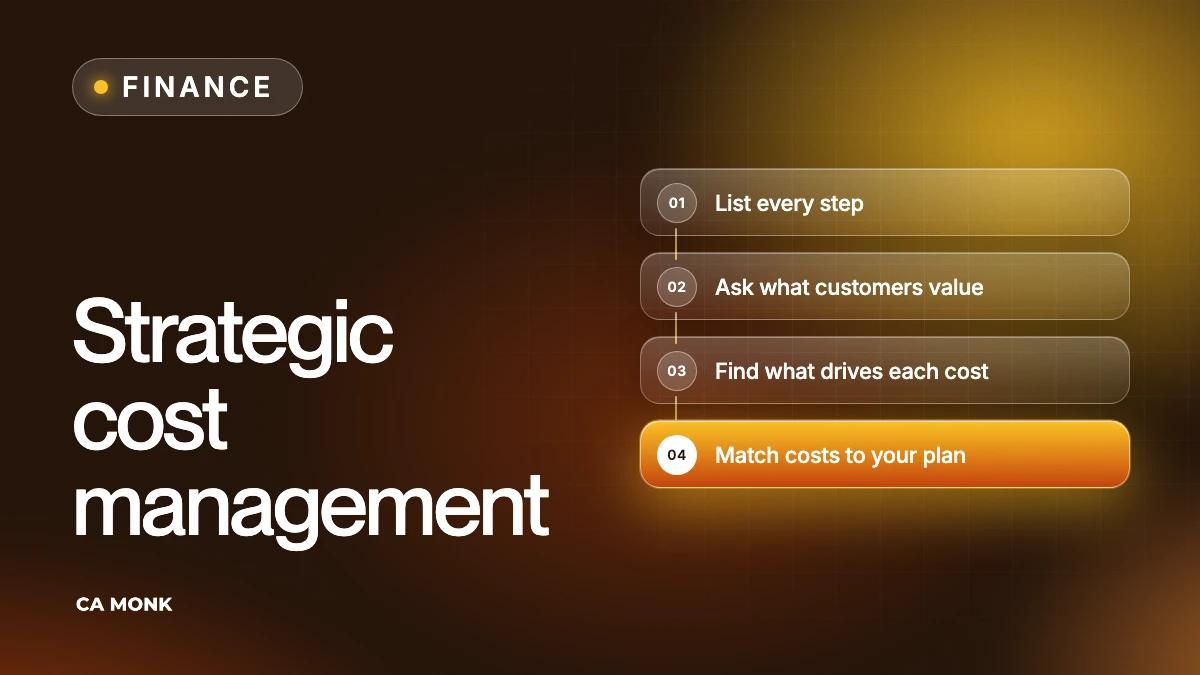
Strategic cost management looks at a business through three linked lenses. Anita uses them in order.
The idea of the chain of steps comes from the business thinker Michael Porter's value chain model. The point of splitting costs into steps is that each step has its own driver, so each can be understood and managed on its own.
What the drivers show. Anita looks at delivery first. Her van makes 200 trips a month, each costing ₹500 in fuel and the driver's time. To check that this explains the delivery cost, multiply trips by cost per trip: 200 × ₹500 = ₹1,00,000. It does.
Many trips are half-empty runs to one café. If she plans routes so that each trip serves several cafés, she needs only 100 trips. That costs 100 × ₹500 = ₹50,000, a saving of ₹50,000 a month.
Her monthly costs fall from ₹4,00,000 to ₹3,50,000. Divide by 10,000 loaves again: ₹3,50,000 ÷ 10,000 = ₹35 a loaf. She now keeps ₹15 a loaf (₹50 − ₹35), or ₹1,50,000 a month. The bread is the same, and arrives just as fresh.
What the plan decides. Old-style cost control would also have squeezed the biggest single cost, the flour, by switching to a cheaper brand. Anita has chosen to stand out by quality (differentiation), not by being cheapest (cost leadership). Cheaper flour would save money but damage the one thing her cafés pay her for. So she leaves the flour alone and cuts where customers notice nothing: the empty van trips.
A bakery that chose to be the cheapest in town would have made a different call. The numbers are the same; the plan changes which cut is right.
Treating it as cost-cutting with a new name. Cutting whatever is largest is ordinary cost control. This approach first asks what the business is trying to be, and keeps the costs that serve that.
Looking only at the factory or kitchen. Anita's biggest saving came from delivery, a step after baking. A business with big costs before and after production, in buying, delivery, selling or after-sales service, can miss much of its spending if it only studies the production floor.
Using one driver for everything. Spreading all costs over loaves baked would have hidden that delivery depends on trips. Each step needs its own driver.
A finance team or accountant meets it when management asks where money can be saved, or how to price against a rival. The work is the same as Anita's: list the main steps separately, find the driver behind each, and look at each step for a saving or a way to stand out.
It is also the base for the more detailed tools that follow it, such as working back from a target price to a target cost, or running a business with as little waste as possible. Each of those is one way of doing what this approach describes.
No. Cutting costs asks "what is expensive?". This asks "what are we trying to be, and which costs serve that?". A gym that wins members on its trainers would keep paying them ₹40,000 a month and save instead on, say, ₹20,000 of unused floor space.
It is whatever makes a cost go up or down. A coaching class's printing cost might depend on the number of mock papers printed, not on how many people enrol. If 1,000 papers cost ₹5 each, that is ₹5,000; print 600 and it is ₹3,000.
Because much of the money may be spent before or after it. An online seller that spends ₹2,00,000 a month making goods and ₹3,00,000 packing, shipping and handling returns would miss most of its costs by studying only the making.
If you want to see the tools that build on this approach, these posts are a good next step.

CA MONK Team
CA Career & Learning Platform
CA MONK Team is the team behind CA Monk, India's CA career and learning platform. We help Chartered Accountants and CA aspirants build skills, explore career opportunities, connect with mentors, and navigate their professional journey through courses, mentorship, career tools, placements, and practical industry insights.
What does CA do in India? Learn the real roles, duties, and scope of CA work. Simple and student-friendly guide.

