Article Topics
Supply under GST is the word GST uses for a deal it counts at all. GST is a tax on selling goods and services in India. Before anyone asks how much GST is due, there is an earlier question: was the deal a supply? If a deal is a supply, GST may be due on it. If it is not, GST has nothing to tax.
Section 7 of the Central GST Act says what a supply is. In everyday terms, it is selling, swapping, renting or licensing goods or services, when it is done for a payment and as part of running a business. And "as part of running a business" is its own phrase too: in the course or furtherance of business.
Take Sweet Crumb, a bakery in Bengaluru. In October it did five things:
The owner's first guess is that only what customers paid for counts. That would be ₹4,00,000 + ₹30,000 = ₹4,30,000. As we will see, the right answer is ₹4,80,000, because one thing given free still counts and two things do not count at all.
The cakes sold to customers. Customers pay Sweet Crumb, and selling cakes is what the bakery is in business to do. A sale, for a payment, as part of the business: a supply of ₹4,00,000.
The old oven. Selling the oven is not Sweet Crumb's main trade. But it is still a sale, for a payment, and the oven was used in the business. It is a supply of ₹30,000.
The cakes sent free to the kiosk. Here no money changed hands when the cakes left the bakery. Normally that would mean no supply. But the law keeps a short list of deals that count as supplies even without any payment (Schedule I). One of them is goods sent by a business to an agent who sells them on its behalf. The kiosk owner is exactly that. So sending the cakes is a supply of ₹50,000, even though Sweet Crumb has not yet been paid a rupee.
The same list catches a few other free deals:
The Diwali hampers. These are gifts to staff, with no payment. A gift from an employer to an employee is not a supply if what that employee gets in the financial year is ₹50,000 or less. Each person got ₹4,000, far below that. The hampers are not a supply.
The salaries. A baker's work for the bakery is a service in plain terms, and the bakery pays for it. Yet the law says outright that an employee's work for the employer is not a supply of goods or services. It sits on a short list of things kept out of GST altogether (Schedule III). Others on that list include the work of courts and tribunals, the work of elected members of legislatures and local bodies, and services by a foreign embassy in India.
Now Sweet Crumb adds up what counts. It takes the customer sales of ₹4,00,000, adds the oven at ₹30,000, and adds the cakes sent to the kiosk at ₹50,000, because that free deal is on the list. It leaves out the hampers and the salaries. ₹4,00,000 + ₹30,000 + ₹50,000 = ₹4,80,000 of supplies in October. That is ₹50,000 more than the owner's guess of ₹4,30,000.
"No payment, so no GST." Many deals without payment are indeed not supplies. But the free deals on the Schedule I list are, like Sweet Crumb's cakes at the kiosk. Missing one leaves a supply out of the GST return.
Mixing up "exempt" and "not a supply". Some supplies are exempt. They are still supplies, just ones the law leaves untaxed. The Schedule III items, such as salaries, are different: they are not supplies at all.
Taxing a bundle wrongly. Say Sweet Crumb sells a birthday package: a cake with free delivery. The cake is the main thing and the delivery comes with it, so the whole package is taxed at the cake's rate (a composite supply). But a festive box of sweets, dry fruit and a toy, sold together at one price with no main item, is taxed at the highest rate of any item in the box.
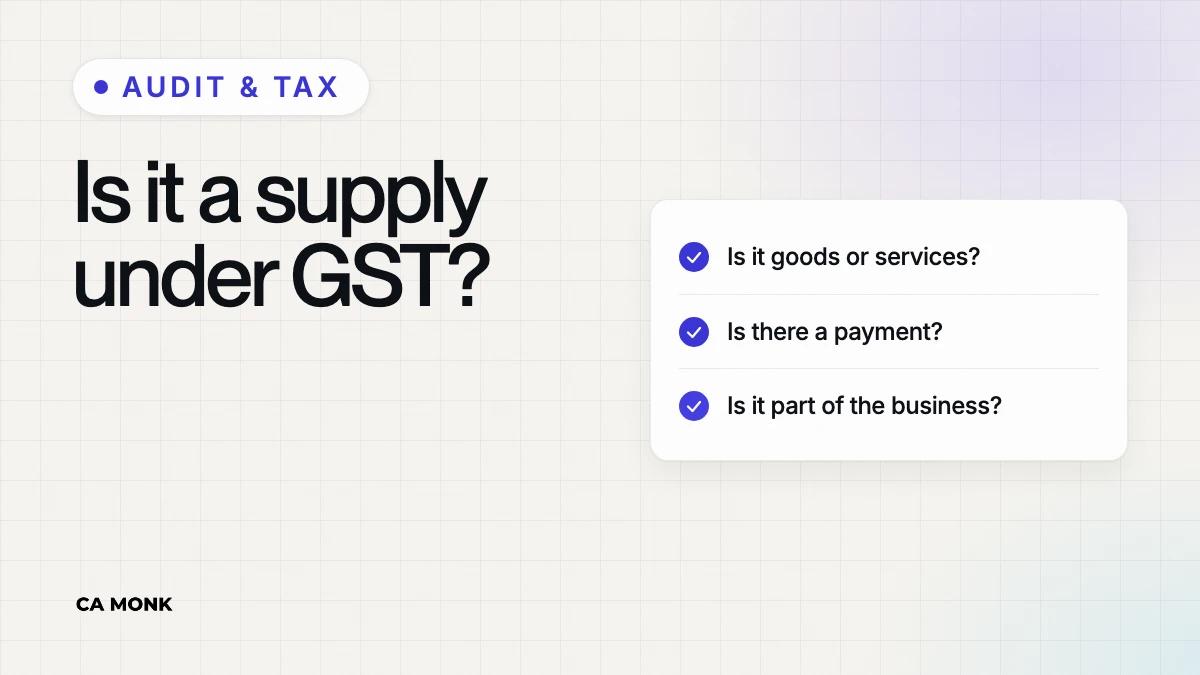
When an accountant reviews a business's GST, the first check on each deal is the one Sweet Crumb just did. Is it goods or services? Is there a payment? Is it part of the business? Only after a deal is found to be a supply do they sort it into taxable, exempt or zero-rated. That sorting decides how much GST is due and how much credit the business can claim for GST it paid on its own purchases.
To back up each answer, the business keeps its invoices, contracts and agreements, such as Sweet Crumb's written terms with the kiosk owner. And at regular intervals the accountant matches the GST returns against the accounts, so a deal counted as a supply in one is counted the same way in the other.
Usually not, but there are listed cases. A tailor who sends ten shirts free to a shop that sells them on the tailor's behalf has made a supply. So has a business giving away for good a machine on whose GST it already claimed credit.
No. An employee's work for the employer is kept out of GST altogether. A gym paying its trainers ₹2,00,000 a month in salaries records no supply for it.
Not if each employee's gifts in the financial year come to ₹50,000 or less. A shop that gives each worker a ₹5,000 gift card makes no supply. If one manager got gifts worth ₹60,000 in the year, those gifts would count as a supply.
This post was checked against the law in November 2026. Laws change, so read the official text before you act on it.
These posts explain the next questions GST asks once a deal is found to be a supply.

CA MONK Team
CA Career & Learning Platform
CA MONK Team is the team behind CA Monk, India's CA career and learning platform. We help Chartered Accountants and CA aspirants build skills, explore career opportunities, connect with mentors, and navigate their professional journey through courses, mentorship, career tools, placements, and practical industry insights.
What does CA do in India? Learn the real roles, duties, and scope of CA work. Simple and student-friendly guide.