Article Topics
AI in banking in India is already at work in customer-service chatbots, fraud detection and loan decisions. The Finance Ministry told Parliament so on 27 July 2026. The RBI has also issued a report with seven principles for using AI responsibly. For CAs, the work moves towards checking what these systems decide: credit, risk, audit and compliance.
Last updated: 23 November 2026.
The clearest public answer comes from the government. On 27 July 2026, the Finance Ministry gave a written answer in the Lok Sabha, the lower house of Parliament. It listed where the financial sector is adopting AI and machine learning (software that learns patterns from past data):
Public sector banks, the ones the government owns, give more detail. Each year they agree a reform plan called EASE. For 2025-26, its focus included generative AI, which writes text and answers questions, and agentic AI, which carries out tasks on its own. The Finance Ministry's answer on these reforms, given on 16 March 2026, also reported that:
The RBI has also rolled out a tool of its own. MuleHunter.AI uses AI and machine learning to find mule accounts: bank accounts used to pass on money from cyber fraud. In its answer on mule accounts of 16 March 2026, the Finance Ministry said it was live in 26 banks and being scaled up. Banks have also been advised to use AI and machine-learning tools to spot suspicious and fraudulent transaction patterns.
The main document is the RBI's FREE-AI report, issued on 13 August 2025. FREE-AI stands for Framework for Responsible and Ethical Enablement of AI. The RBI's press release on the FREE-AI report is the place to start. The report sets out seven guiding principles, which it calls sutras:
Read the list as a CA would. Two of the names, "Accountability" and "Understandable by Design", point to the same need. When a model turns down a loan or flags an account, someone should be able to explain why and answer for it. Explaining and checking numbers is the work CAs are trained for.
Two other official papers sit beside it. The Ministry of Electronics and Information Technology (MeitY) has released the India AI Governance Guidelines, which apply across sectors. The Indian Computer Emergency Response Team (CERT-In) is the government's cyber-security team. On 26 April 2026 it issued an advisory on defending against cyber risks from frontier AI, meaning the most advanced AI models.
Older rules still apply too. The Finance Ministry's March 2026 answer on mule accounts gives one example. Under the RBI's Master Directions on Fraud Risk Management, every commercial bank must have a fraud risk policy approved by its Board. An AI fraud tool works inside that policy, and someone has to check that it does.
Nobody can answer this with certainty, and you should be wary of anyone who claims to. What the official record shows is narrower than the fear. In the examples above, AI does three kinds of work. It flags (an odd transaction, a possible mule account). It scores (a loan application). It answers (a customer's routine question, a reminder to repay).
Flags and scores still need a person to decide what happens next. Is the alert a real fraud or a false alarm? Should the bank lend, and on what terms? Is the result fair to the customer?
Routine CA work is the easiest to hand to software: matching entries, ticking samples, reading every line of a ledger. Judgement and responsibility are much harder to hand over. That means seeing what a borrower's accounts hide, deciding whether an alert is real and signing a finding you can defend.
So a better question than "Will AI replace me?" is "Which parts of my work will AI do, and am I good at the rest?" For a wider look, read what is actually happening with AI in finance in 2026.
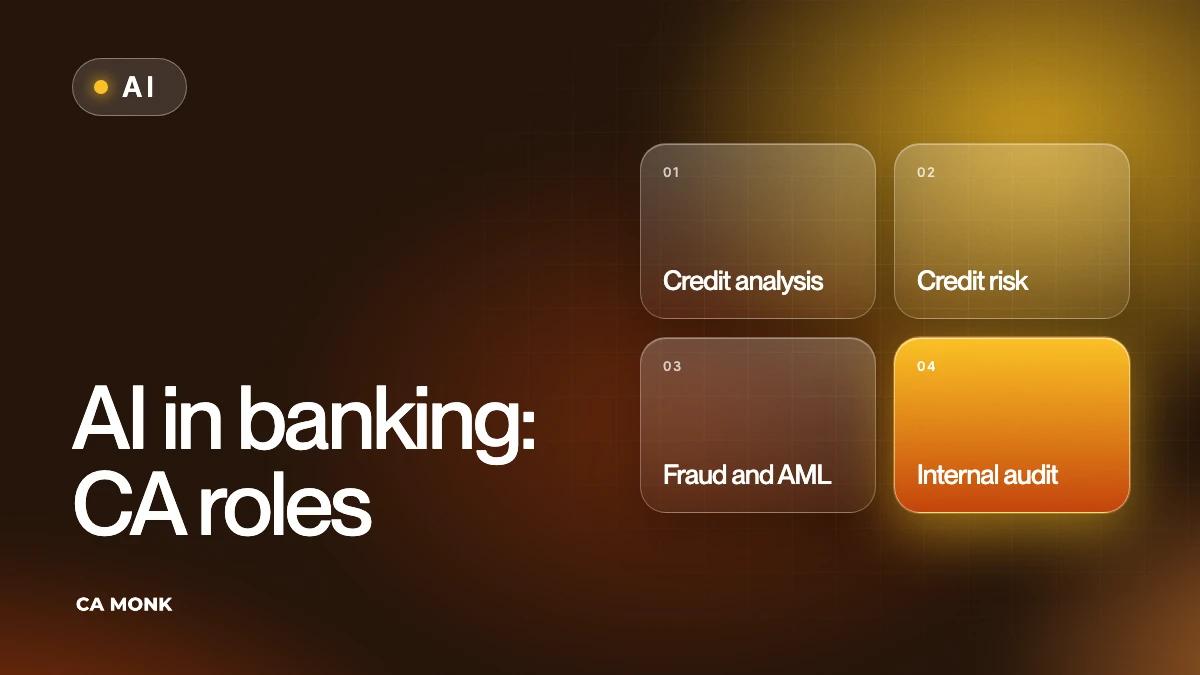
In each role below, the machine does the first pass and you do the part that needs judgement.
| Role | What AI does | What the CA does |
|---|---|---|
| Credit analysis | Scores the loan application | Reads accounts, judges the borrower |
| Credit risk | Estimates likely loan losses | Tests the assumptions behind it |
| Fraud and AML | Flags suspicious transactions | Reviews alerts, decides next step |
| KYC and compliance | Identifies and monitors customers | Checks the process meets the rules |
| Internal audit | Makes decisions to be tested | Tests controls around the model |
| Model validation | Produces scores and forecasts | Checks data, results and records |
Credit analysis. Loan systems now gather a borrower's accounts, bank statements and GST data for you. That saves hours of collecting. It does not tell you whether the business is sound. You still read the cash flow and how the debt will be repaid. You still check related-party dealings, meaning deals with the owners' own firms or family. If this role interests you, read our guide to the credit manager interview at large private banks.
Credit risk. Expected credit loss (ECL) models estimate how much of the money a bank has lent may not come back. The public sector banks' 2025-26 reform list includes a focus on ECL models. It also covers early warning signals, the signs that a borrower may be heading for trouble. A CA who understands provisioning (setting money aside for loans that may go bad) can test whether a model's assumptions make sense.
Fraud and AML. Anti-money-laundering (AML) work and fraud checks start with alerts from tools such as MuleHunter.AI. Each alert is only a lead. Someone has to look at it, decide whether it is real, and act under the bank's fraud policy.
KYC and compliance. Know-your-customer (KYC) checks confirm who a customer is. The reform list includes anti-money-laundering checks when customers open accounts, and better models to identify mule accounts. A compliance team checks that the process, with AI inside it, still meets the rules.
Internal audit. When a model takes decisions, auditors test the controls around it. Who approved it? What data does it use? Who can change it? What happens when it is wrong?
Model validation. This means checking that a model does what it claims. It is often statistics-heavy work. A CA can support it by testing the data that goes in and comparing the model's results with what actually happened.
You do not need to become a programmer. You need to understand what goes into a model, what comes out, and how to tell when the output is wrong. A practical order:
If you want a guided start, CA Monk's Level 1 AI for Finance Masterclass is one place to begin.
Nobody can say for certain. What the official record shows is AI flagging transactions, scoring loan applications and answering routine questions. Deciding what a flag means, whether to lend and whether a result is fair still needs people. That is where CA training in accounts and rules helps.
It is the RBI's report on using AI responsibly in the financial sector, issued on 13 August 2025. FREE-AI stands for Framework for Responsible and Ethical Enablement of AI. It sets out seven guiding principles, called sutras, including People First, Accountability and Understandable by Design.
MuleHunter.AI is an AI and machine-learning tool the RBI rolled out to detect mule accounts. These are accounts used to move money from cyber fraud. The Finance Ministry told the Lok Sabha on 16 March 2026 that it was live in 26 banks and being scaled up.
Yes. In March 2026 the Finance Ministry said seven public sector banks had deployed at least one use of generative AI. And 10 had AI-driven voice bots and WhatsApp chatbots to follow up on unpaid loans. Their 2025-26 reform plan also focused on generative and agentic AI.
Not to start. For the roles in this post, the first need is to understand the data going in and judge the result coming out. Strong Excel and the habit of testing numbers come first. SQL or Python helps later, if you move towards analytics or model validation.
If you are thinking about a finance career with AI in the picture, these posts are worth reading next.
AI for Finance - Level 1

CA MONK Team
CA Career & Learning Platform
CA MONK Team is the team behind CA Monk, India's CA career and learning platform. We help Chartered Accountants and CA aspirants build skills, explore career opportunities, connect with mentors, and navigate their professional journey through courses, mentorship, career tools, placements, and practical industry insights.
Explore Credit Manager roles for CAs in banks. Learn job profile, salary, interview questions, and banking career path after CA in India.