Article Topics
What financial policy and corporate strategy mean, with one bakery chain
Financial policy and corporate strategy is about making two things fit: a business's plan and its money. Every business has a plan for where it wants to go: more shops, a new product, a new city (corporate strategy). It also has to decide where the money for that plan comes from, how it is spent, and how much is handed back to the owners (financial policy).
A plan the money cannot pay for is a wish, and a money policy that ignores the plan is just bookkeeping.
Here is the case. Golden Crust is a family-owned chain of 10 bakeries. The family has ₹1,00,00,000 of its own money in the business. This year the chain made a profit, after tax, of ₹20,00,000. Out of that profit, the family takes ₹12,00,000 as dividends to live on, and leaves ₹8,00,000 in the business.
The eldest daughter, who now runs the chain, has a plan: grow by 20% a year. On 10 shops, that means 2 new shops this year. Each new shop costs ₹10,00,000 to fit out and stock. So the plan needs 2 × ₹10,00,000 = ₹20,00,000. The business has kept only ₹8,00,000. Something has to give.
Three money decisions that pull on each other
Behind every plan sit three money decisions:
- What to spend on. Here: two new shops at ₹10,00,000 each.
- Where the money comes from. Here: the profit the family leaves in the business, or a bank loan, or new money from the family or outsiders.
- How much profit to hand back to the owners. Here: the ₹12,00,000 of dividends.
These cannot be decided one at a time. If the family takes more as dividends, less profit stays in the business. Then more must be borrowed, and the business carries more debt and more risk. A choice on dividends is therefore also a choice on borrowing, and on how big the plan can be.
How fast the business can grow on its own money
There is a quick way to see how far the kept profit will go. First, work out how much profit the business earns on the owners' money. Divide the profit by the owners' money: ₹20,00,000 ÷ ₹1,00,00,000 = 20% (the return on equity).
Next, work out what share of the profit stays in the business. Divide what is kept by the whole profit: ₹8,00,000 ÷ ₹20,00,000 = 40% (the retention ratio).
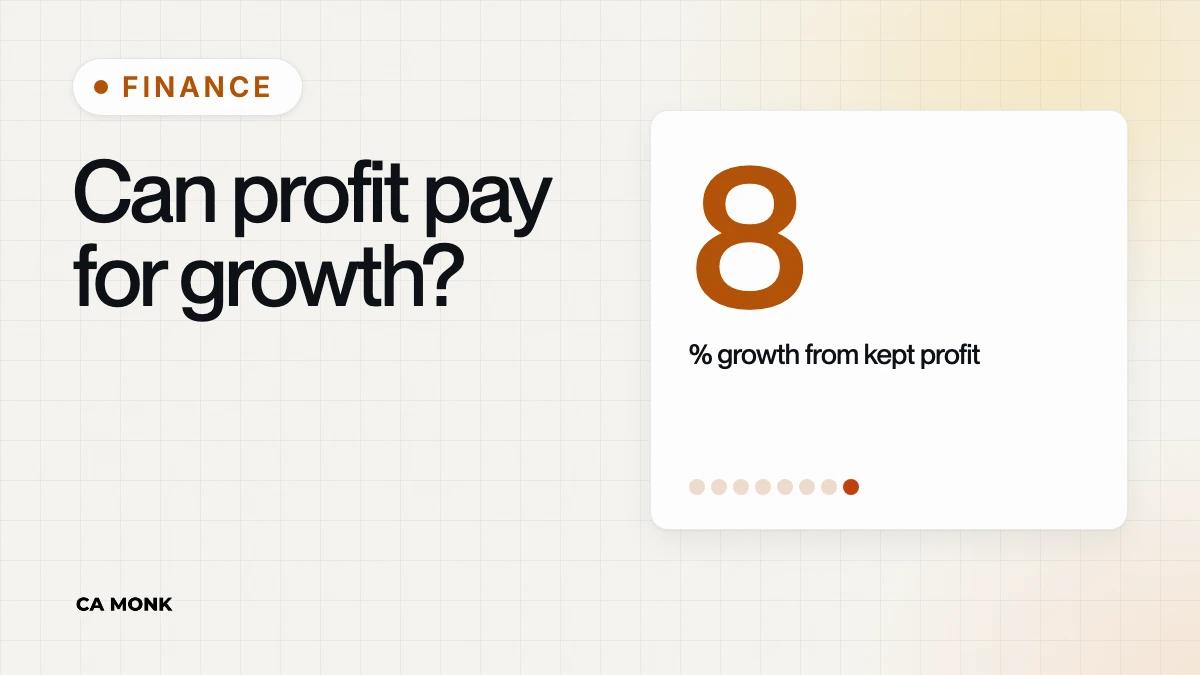
Multiply the two: 20% × 40% = 8%. That is how fast Golden Crust can grow out of the profit it keeps, without raising money from outside (the sustainable growth rate).
The plan asks for 20%. The money supports 8%. The gap this year is ₹20,00,000 − ₹8,00,000 = ₹12,00,000. The daughter now has to choose.
The choices, and what each one costs
Keep all the profit. If the family takes no dividends, the business keeps the whole ₹20,00,000. The share kept becomes 100%, and the growth it can fund is 20% × 100% = 20%. The plan is paid for, but the family loses ₹12,00,000 a year of income.
Borrow the gap. The family keeps its ₹12,00,000 of dividends and the business borrows ₹12,00,000 from a bank. Interest on a loan cuts the business's tax bill (a tax shield). That is why debt can look cheap. But the loan must be repaid whether the new shops do well or not. The bank may also attach terms, such as limits on further borrowing. More debt means more risk.
Meet in the middle. The family takes ₹4,00,000 instead of ₹12,00,000. The business then keeps ₹16,00,000, which is 80% of the profit. The growth it can fund from its own money becomes 20% × 80% = 16%. It borrows the remaining ₹20,00,000 − ₹16,00,000 = ₹4,00,000.
Slow down. Open one shop this year and accept slower growth.
None of these is right for every business. The point is that each one is a choice about the plan, the borrowing and the dividends together. Bringing these choices together is a big part of the job of a company's chief financial officer.
There is one more pull on the money. A new shop needs flour, staff wages and rent paid before its first customers arrive. Day-to-day cash must still cover those bills while the business grows.
What people get wrong
The first mistake is to decide the three things separately. A family that raises its dividends without looking at the expansion plan forces the business to borrow more, whether anyone meant it to or not.
The second is to think debt is always the better choice because of the tax shield. Against it weigh the fixed repayments, the bank's terms and the cost of trouble if sales fall short.
The third is to judge every project against the same required return. Say Golden Crust insists every project earn at least 12% a year. A new shop on a busy street and a new delivery app are both expected to earn 15%. Both pass. But the app is far riskier. If the family would want 20% to take that risk, the app should be turned down.
Frequently asked questions
Is financial policy the same as accounting?
No. Accounting records what has happened. This topic is about choices still to be made. Golden Crust's accounts show a ₹20,00,000 profit. Deciding whether ₹12,00,000 of it goes to the family or into two new shops is a question about the business's future, not its books.
Why can't a business grow as fast as it wants?
Because growth needs money. Each new Golden Crust shop costs ₹10,00,000. With ₹8,00,000 of kept profit, the chain can grow about 8% a year on its own. Going faster means taking less out as dividends, borrowing, or bringing in new owners.
Is a high dividend payout bad for a company?
Not by itself. It suits a business with few good places to spend money. But Golden Crust has a plan for new shops. Every rupee it pays out is a rupee it must borrow or do without. Here, a ₹12,00,000 dividend leaves a ₹12,00,000 gap in the plan.
The official text
- Financial policy and strategy: the official text (ICAI)
- PAPER 2: ADVANCED FINANCIAL MANAGEMENT (100 MARKS) (ICAI)
- Assignment – Financial Policy and Corporate Strategy - AFM - Final Level (ICAI)
This post was checked against the law in November 2026. Laws change, so read the official text before you act on it.
Where to go next
These posts look at related decisions on raising and using a business's money.
Finance Masterclass


