Article Topics
Every year a company puts out its accounts: what it owns, what it owes, what it earned and what it spent. Ind AS 1 (Presentation of Financial Statements) is the rule book for how those accounts are laid out. It says which reports must be in the pack, how items are grouped and sorted, and what must sit beside them.
It does not decide what anything is worth. Other standards do that. Ind AS 1 decides where each figure goes and how it is shown. The aim is that this year's accounts can be read against last year's, and against another company's.
Take Crumb & Co., a small bakery company in Indore. It bakes cakes and bread and sells some of them through a café in town. Its year ends on 31 March 2026, and its accountant, Meena, now has to put the year's accounts together.
One line shows what the rule changes. The bakery took a ₹10,00,000 bank loan to buy ovens. It repays ₹2,00,000 every year. Ind AS 1 says the part due in the next twelve months is shown apart from the rest. So Meena takes the ₹2,00,000 due this coming year away from the ₹10,00,000:
₹10,00,000 − ₹2,00,000 = ₹8,00,000
The accounts show ₹2,00,000 as owed within a year and ₹8,00,000 as owed later. One loan, two lines.
Meena starts by asking whether the bakery will keep running. The managers have to judge this. If they mean to close it, or have no real choice but to close, the accounts are drawn up on a different footing. Crumb & Co. is trading well, so she prepares them on the usual footing that it carries on (going concern).
Next she counts each sale and each cost in the year it belongs to, not the year the money moves (accrual basis). On 28 March the bakery delivered a ₹40,000 wedding cake. The customer paid on 10 April. The ₹40,000 still counts as a sale in the year to March 2026. Only the report on cash shows it in April, when the money came in.
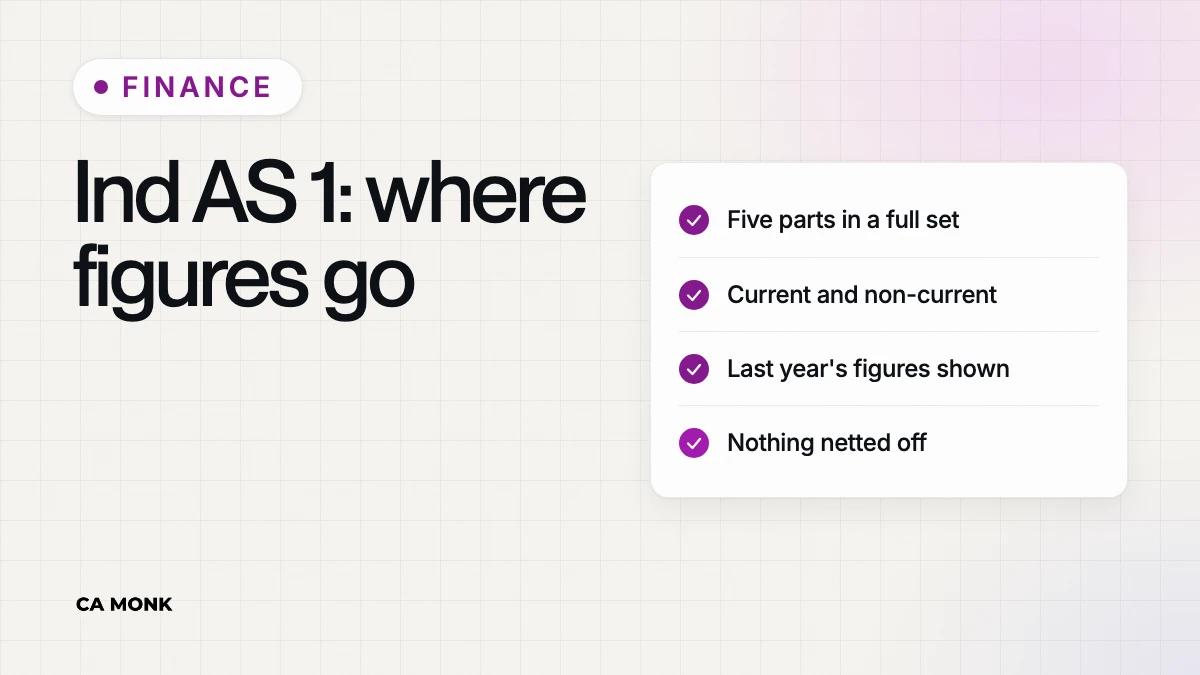
Then she builds the pack. A full set has five parts:
Each report shows last year's figures in a column beside this year's. A reader sees at once what moved.
Now she sorts the list of what the bakery owns and owes. Each item goes either in a "within a year" group or a "later" group (current and non-current). Here is what she has:
To see what the bakery must pay within the year, Meena adds the three bills plus this year's loan repayment:
₹1,50,000 + ₹20,000 + ₹2,00,000 = ₹3,70,000
Had she left the whole loan in "later", that figure would read ₹1,70,000. The bakery would look as if it owed less than half of what it really has to pay in the coming year.
She also keeps like with like. Each big group of similar items gets its own line. Items of a different kind get separate lines, unless they are too small to matter.
Last, she checks the layout against last year's. It stays the same unless a standard requires a change, or the new layout gives clearer and more reliable information.
Netting one figure against another. The café owes the bakery ₹50,000, and the bakery owes the café ₹20,000. It is tempting to show one line: the café owes ₹30,000 (₹50,000 − ₹20,000). Ind AS 1 does not allow this unless another standard requires or permits it. Meena shows ₹50,000 as owed to the bakery and ₹20,000 as owed by it, on separate lines.
Using only the twelve-month test. Some businesses take longer than a year to turn materials into cash: buying, making, selling and collecting the money (operating cycle). Say a furniture maker takes 18 months to turn timber into money in the bank. Its timber still goes in the "within a year" group, because it will be used up within that normal cycle.
Expecting it to put a value on things. Ind AS 1 does not tell Meena what the ovens are worth or when to count a sale. It only governs how the figures are grouped, shown and explained.
Accountants who prepare a company's yearly accounts use it all the time. Meena uses it to decide which group each balance goes in, how profit is shown, and which past-year figures and notes go with the reports.
Auditors use it too. They check that items sit in the right groups, that the layout matches last year's, that past-year figures are there, and that nothing has been netted off when it should not be.
No. It decides how the profit is shown, not how much it is. If the bakery made a profit of ₹6,00,000, other rules work that figure out. Ind AS 1 decides which report it appears in, what it sits next to, and that last year's figure is shown beside it.
So a reader can see what changed. If the bakery owed ₹2,50,000 within a year last March and ₹3,70,000 this March, the two columns show a rise of ₹1,20,000 at a glance.
Not as a rule. It is allowed only where another standard requires or permits it. If a café owes the bakery ₹50,000 and the bakery owes the café ₹20,000, both figures are shown. Writing just ₹30,000 would hide both amounts from the reader.
Related reading and courses:
Ind AS Masterclass

CA MONK Team
CA Career & Learning Platform
CA MONK Team is the team behind CA Monk, India's CA career and learning platform. We help Chartered Accountants and CA aspirants build skills, explore career opportunities, connect with mentors, and navigate their professional journey through courses, mentorship, career tools, placements, and practical industry insights.
Explore differences between IND AS, IFRS and US-GAAP, and what finance leaders need to know for successful adoption and global compliance.